Friday, July 3, 2009

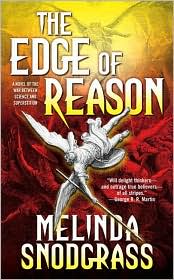
The Edge of Reason by Melinda Snodgrass

Since my "to read" bookshelf has 16 titles I don't honestly know why I keep buying books. It's an addiction, it has to be! In any case even though I knew I had all those titles on my shelf I still wondered into Page One with a couple bucks in cash. It's to the point that I know what I want to read, but don't want to start it because it's a series. I have all sorts of series to read already so I really don't want to start another one, well that's not true, I do want to start them all of them, but the fact is I don't have time to read them! So I go in, meander about for 20 minutes before heading to the little counter for help--I know me a worker at my own bookstore needing help. So I ask the guy there who was the person that knew the most about sci-fi/fantasy--it turns out it was him--and ask him the most difficult question I get asked: "I need a great fantasy or sci-fi that is a single novel, not a series, not stand alone in a universe, but a single fully contained novel." Trust me on this, this question is a whore and loaded to all hell because everyone knows the best aspects of sci-fi/fantasy are their epic series, see Tolkien, Goodkind, Herbert, and Feist just to name a few. His face betrays exactly what I said above in a grimace, I can't blame him, but then I added the fact that I've read a whole hell of a lot already so it might be tougher than usual. We headed over to the section and as we walked he tossed a couple no brainers at me: Crichton, Bradbury, Heinlein, and Dick. All the ones he mentioned I had read save for a Phillip K. Dick whom I was not in the mood for. Then he asked a question that threw me off "how do you feel about religion?" Whew that was one thing I didn't expect at all! I shrug and give him the most non-offensive answer I could while still being true with myself "Eh I'm not a fan, it's all kinda a joke to me." Again this guy throws me off and he laughs and says "I've got a book you have to read!" Here I was thinking he was gonna set me up with a religious themed fantasy--gag--instead he shows me a local author named Melinda Snodgrass who just came out with a new book called The Edge of Reason.
The quote on the cover from George R.R. Martin reads:
"Will delight thinkers--and outrage true believers--of all stripes"

He tells me, basically, that she bashes every major world religion AND governments. Say no more my friend, say no more! Unfortunately for them it was new so I decided to hold off and pick it up with my discount at my work, but in the meantime another guy overhears us who was on break and brings up L. Ron Hubbards book Battlefield Earth. Yikes, Hubbard, really? Whole load of crazy right there. They both assure me that this one was pre-psycho lets start a religion Hubbard and I also remembered that my uncle read most of his pre-crazy books as well and like them, so for 2 bucks I picked it up. I haven't started it yet, but it should be.. an interesting experience to say the least. Hopefully I can keep my bias out of it and just try and enjoy it as a good piece of sci-fi. I'll let you guys know.

So crazy cult leaders aside, this book was amazingly entertaining! Before I go into the plot and symbolism's of the book I have to get some dumb things out of the way. Now I have no right to criticize anyone on their writing, grammar, or mechanics since I suck horribly at all three, but as a reader I have certain expectations of the authors I read. I expect that, as a professional, you won't have too many silly typos/misspellings, I expect that if this isn't your first book that your plots aren't as see through as a third graders, and I expect that your sentence structure and syntax are much more complex than that of a middle schooler. Ms. Snodgrass does a good job with most of the stuff, but I felt myself getting distracted by a rather way of talking. It wasn't horribly confusing just a couple points needed to be re-read so I was comfortable with what I read, there were some silly mistakes here and there, probably due to her editor being lazy over her, and the biggest down to her book was the fact that she kinda gave everything away within the first 100 pages. The grammar and poor editing aside, seeing an author tell all about a plot and the characters so early in a book is a major turn off. There were a couple surprises in the end, and obviously this one is a start of a series so the end itself was rather eh. By the way I took this book because the rest of the series isn't out so I have time to read my other stuff! Generally though aside from some flattish characters--whom I expect will be developed more further in the series--and a plot given away like a drunk virgin, it was a good book.

Like I've said before I'm not going to write a book report for you guys, if you're intrigued by it go pick it up! The thing that made me the happiest was the fact that she grouped ALL of the religious together, she wasn't picking on one over the other, she came right out and said that the entire idea of religions is stupid. Not only that, she made religion and their "gods" into evil creatures using superstition and stagnation to enslave mankind. Indeed one of the major characters is named Cross and he's guess who? Jesus Christ! But really he's a powerful "old one" whom has been converted to the side of reason and logic. The kickass thing about Cross that Ms. Snodgrass uses to attack religions even more is this: He's a schizophrenic! That's right, he's been here since we evolved and based on the cultural view of wherever he is he becomes either Jesus for Christians, Yehoshua
for the Jews, and Allah for the Muslims. So not only are these stupid religious people fighting each other under THE SAME GOD, but they're being controlled and enslaved by every "god" throughout human history. She addresses one of the major things I have a problem with in Christianity which is the fact that in the Old Testament God was an asshole. He killed us, punished us, made us suffer, and overall enjoyed it, this is, she explains, because that's how these creatures thrive ff human suffering. Until one of the other major characters comes in and changes the view of a spiteful angry god into that one of compassion these creatures used holy wars and all those awful things that happened to become stronger. Christians always tend to play off those atrocities as God "testing us", but in reality they were doing it for their own pleasure. Oh man she did it so eloquently and so masterfully that I totally let most of her almost poor writing go and gave her a 7/10 on my list. Another theme that played a smaller role in the book was that of corruption and how if you have enough money you could be the most evil, vile person on the world and get away with anything. It also addressed aspects of homophobia, race, and family.

If you're iffy on religion or hell even if you are religious I think it's a great book to pick up! She's a lot meaner than, say, Christopher Moore's Lamb, but there are things Snodgrass brings up that need to be addressed. Hell it got a good review by the great George R.R. Martin that alone should compel any fantasy fan to pick this up!

Thursday, July 2, 2009

Passion: Tree Houses

As I was cleaning up my store this evening I stumbled upon this amazing book in one of the home sections. It's called Treehouse Living and it brought up emotions in me that I haven't felt since I was a kid!
Naturally I stopped what I was doing and started flipping through it, and guys, this is one of the most gorgeous books I have ever seen! Perhaps it's just me, but I can't think of anything more amazing that being so.. intertwined with nature as a treehouse! Ever since I was a child I've wanted a treehouse, unfortunately living here in New Mexico makes it rather difficult to build one. I have seen a couple pretty neat ones around town, but it's almost impossible to find the proper tree for the designs I have floating in my head, it's just too dry! In any case this book made me think about them again and god damn I swear here and now that when I'm older and richer I will build myself one. I know what you're thinking, "Ryan you're the most not carpentry/building manly man ever" and it's true, but I will do whatever it takes to full fill this dream. I'll even overcome my mild fear of heights and dangle from a tree to build this. I know I'm probably going to need someone there who actually knows what the hell their doing, but I think it would be really gratifying to build my own! I suck at drawing so I haven't tried to draw one in a really long time, but maybe I'll start playing with sketches--hahaha doodles more likely--look at a few books like the one above and try and get an idea of what I want.

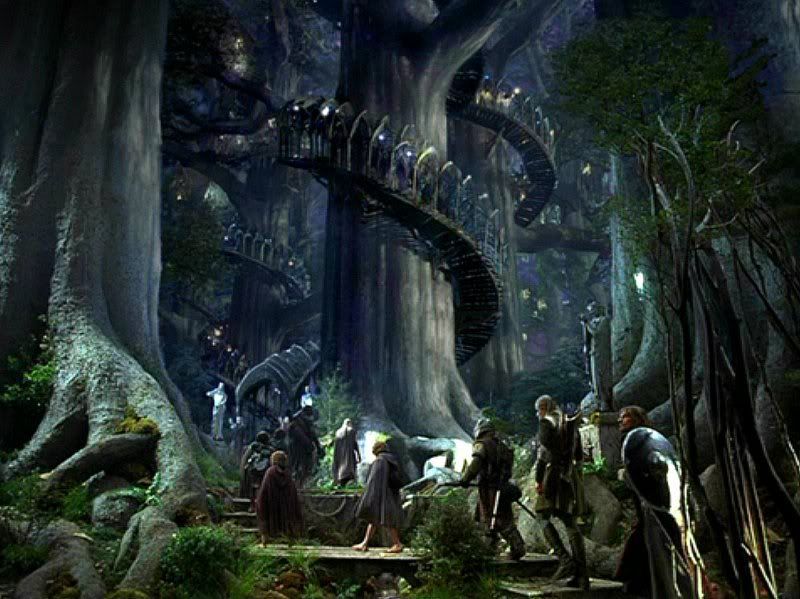
Like I said I've always loved the idea of treehouses even now I don't know why exactly. They've always seemed magical to me probably because my favorite mythical creature is the elf and in every amazing fantasy the elves live in forests and have cities in the trees. From Tolkiens Lothlórien to Feists Elvandor, fantasy has always blown my imagination away with it's elven cities.. the peacefulness, the calmness, the pure magic of it all has always captured my heart. Granted realistically I can't really expect to have a treehouse even comparable to those of Lothlórien or Elvandor, I think I can make something really cool!

Lothlórien

So naturally I came home and got online to check out what cool designs I could find and sadly there aren't any very good pictures out there. I did find a few that are really pretty, but I may just have to purchase that book at some point and upload the pics, or maybe I'll take some shots with my phone next time I'm working. For now, here's some cool treehouses I found! If you know of any please link them for me!

This one is the same as on the front of the book, except in winter obviously

This one I absolutely adore!

The same as above, from the front! Tell me that isn't AMAZING! Gah!

This one is kinda rickety, but it's still gorgeous

Another amazing one, I think I want mine higher though!

This is another really cool design!
Another thing I can say without a doubt is that I want it to have a spiral staircase up and around the trunk like the first one! This is more than likely because of the fantasy visuals I have in my head, but I also think it looks so freaking cool! I'll have to see what I can do about finding pics of some of the ones in that book. More than likely I'm already breaking some sort of copyright so whatever ya know? Not like I'm making money off 'em!

Monday, June 29, 2009

A Response to Cynics of Love

After reading and discussing love and relationships in class I believe it is very easy to be horribly cynical about love if you've never actually been in love. Dorthy Parker is a prime example, sure I'm not 100% positive if she was married or not, but I can say with a high degree of certainty that she has never been in true love. When you're with someone that takes your breath away every time they walk into a room you can count to a million and not get bored. Besides she says "men delight in novelty" so do women! Just because you have to give some thought about being with your lover doesn't mean there's no novelty! People who are cynical about love and relationships are, at least in my opinion, lazy. Being single is easy; you only have one person to please. I can tell you, though, that pleasing both you and your significant others a million times more rewarding than it will ever be to just please yourself. Don't hat on lovers because you're too lazy to put any sort of effort into a relationship. That's what a relationship is: caring about someone SO much that you'll do everything and anything in your power to make them happy. That may mean giving something up for yourself, or not doing what your id tells you to do, but no matter what the amount of effort you put in will be paid back a million fold.

As for monogamy in general I believe it works. It may not work for everyone, but I've never been happier than when I am with Kimberley. When we're apart I feel so empty and.. alone.. I can't stand the thought of being without her. You may think that amazing new relationship sorta deal, but we've been together way past that stage. Sure it's not that sappy uber newness, but I feel that it's far better now than any new relationship can be. We know so much about each other, we're so.. compatible! One of the things that fuels a new relationship is that feeling of not knowing if it will work; you're both afraid so you try harder and do more for the relationship. In the end, though, it has the chance of ruining the whole thing because that's not who you really are. Or you fool yourself into thinking it's what you want and when it does work out you realize you don't.

So for me, I love her with every part of my being and I truly believe that it will only get better from here. As far as those naysayers, just wait til true loves comes and blows you away! When it does you'll look back on your cynicism and bitter poetry as an older person looks back on a young ones naivety. Trust me on this, true love is an out of the world experience and no crappy poet will change that. I seriously think that it's not peoples place to talk about things they don't know or understand, especially things that are truly magical. Love is one of those things! It's so easy to bitch and moan about how you don't have anyone and how love is stupid and how you despise the whole idea, but if you just took a quarter of that so called "passion" and energy and put it into finding another person you'll find out what it really means. Why is it that as humans we would much rather rant and rave about things that bother us, but yet never actually do anything to change those things; Even when it's in our best interests to go out and do something with our lives and find true love. I understand it's hard, I do, but why must you become a bitter person and try and burst everyone else's bubble? I'm sorry you don't have a love or you had a bad break up or whatever it is that's making you a bitter person, but I don't think you have any right to write shitty lyrics or poetry proclaiming how evil and wrong love is. It's an amazing thing and it makes people happy. That in and of itself should make a difference and make you open your eyes and find someone, or to actually work for your relationship because news flash, cheating on your partner is not the way to go. Sex is a very small part of a relationship, it's needed and one hell of a good time, but it is not the substance of your relationship. Just being with the other person should be more than enough to satisfy you, and guess what? If the sex has fallen out of your relationship and it all goes to hell the answer isn't to go fuck around, work through your problems, bring that spark back because if you don't it will all just come crashing down around you. When that happens and you lose not only your sex buddy, but possibly your one true love, it'll hit you the hardest. It's not worth it. Period.

Tuesday, June 23, 2009

Jerry and Molly and Sam

This was one of the choices for my first essay in my English 102 class this summer. The prompt was:
"In Raymond Carver's "Jerry and Molly and Sam," Al sees the dog as a part, at least of what's wrong with his life. What do you see as what's wrong with his life and why?"

In Raymond Carver's "Jerry and Molly and Sam" the main character, Al, is having a wretched year. Unfortunately for Al, he does not approach his many problems in a healthy or even logical way. Instead, Al becomes not only self destructive, but goes on to ruin the lives of those who care for him. Al believes his major problem is Suzy, the family's dog, but in actuality, Al is merely displacing his anger and resentment from his seemingly out of control life onto the dog. From a psychological standpoint, Al classically demonstrates many of Sigmund Freud's various defense mechanisms, and from this point of view, it becomes easy to identify, and possibly fix, Al's problems.

From the beginning of the story the reader is introduced to Al's troubled life: Aerojet where he works is laying workers off, his wife forced him to move into an overpriced home, his fidelity wavers as he suddenly finds himself in an affair, his body is starting to show signs of old age, and, to top it all off, his wife's younger sister, Sandy, keeps popping in and adding financial burden to his life. On top of the financial burden, Sandy is the one responsible for giving Suzy to Al's family. All are classic signs of a midlife crisis with one minor problem: Al is only 31. What is a man to do in such a situation? Blame the dog of course! Carver eloquently opens the story proving this point: "As Al saw it, there was only one solution. He had to get rid of the dog without Betty or the kids finding out…He felt relieved making the decision" (690). In addition to all of Al's problems, it seems that he also has a minor issue with anger management. Carver illustrates this through the tone of the story and the graphic nature of Al's thoughts: "He wished he'd never seen that dog. Or Sandy, either, for that matter. That bitch! … The mere thought of all the twenty-five- or fifty-buck checks, and the one just a few months ago for eighty-five to make her car payment—her car payment, for God's Sake … made him want to kill the goddamn dog" (691). Here the reader gets a glimpse of Al's obsessive aggravation with Suzy that eventually leads him on a downward spiral of destruction and pain to himself and those around him.

Sigmund Freud, whom many consider the father of modern psychology, believed that the mind is made up of three conflicting personas: the id, pleasure based; the ego, self preservation; and the super-ego, values and beliefs. Simply put, the conflict between these three personas in an individual's sub-conscience produces anxiety. According to Freud, humans have what are called defense mechanisms to help deal with this anxiety. Two mechanisms that have become somewhat more common are denial and repression, both of which fall into a category referred to as the Level One Defense Mechanisms. In total there are four categories, each with its own various mechanisms, ranging from the least psychologically detrimental which are in Level One, to the most harmful in Level Four. There are upwards of 20 different mechanisms total, but Al's character best represents the following three: displacement, rationalization, and reaction formation. Sadly all of them come from the Level Three category and are commonly referred to as the neurotic defense mechanisms. Such mechanisms interfere mainly with a person's work and love life, both of which are problems for Al.

Displacement, in the simplest terms, is the act of displacing the aggression one feels for something or someone onto something less threatening. Al is subconsciously displacing all of his anger and resentment caused by his job, his wife, and his body onto the innocent dog. Because Al believes he is losing control of his life, he has to find a safe outlet in which to discharge his overwhelming anxiety. He cannot take it out on his boss for fear of losing his job, he cannot take it out on his wife for fear of breaking up his family, and he cannot he take it out on himself because he truly believes that none of the problems are his fault. In the end, Suzy is the perfect scapegoat, and she is the only thing he can safely release his frustrations on. After she misbehaves a few times Al suddenly justifies the irrational action of getting rid of her because "he had enough to contend with without having to worry about a stinking dog" (Carver 691). This in and of itself is another Level Three defense mechanism called rationalization. By convincing himself that Suzy is the root of all his stress, Al makes his extreme actions justifiable, which, in the end, only lead to heartbreak. In combination, displacement and rationalization can cause terrible heartbreak, and ultimately, cause more anxiety than they save, as the reader sees later in the story. When Al returns home after getting rid of Suzy, he finds his family in uproar; the children screaming for their lost dog, a hysterical wife, and a guilty conscience. Carver expresses the psychological horror as Al begins to realize the magnitude of what he has done: "He kicked the door shut. Everything was going to hell. While he was shaving, he stopped once and held the razor in his hand and looked at himself in the mirror: his face doughy, characterless—immoral, that was the word … I believe I have made the gravest mistake this time. I believe I have made the gravest mistake of all" (697). Actions that were once meant to lower Al's stress level suddenly multiply his anxiety to a point where he truly is out of control. This comprehension leads to an even more horrifying realization for Al and sets him up for reaction formation, the third defense mechanism.

Reaction formation is when a thought or belief causes so much anxiety that the person believes, in an almost manic way, the very opposite of the truth. A common example is with love: one person is flaunting her love in an extremely over the top manner, gushing over her partner, making emotionally intense claims, and, in most cases, smothering the relationship. This is because the person realizes that she actually does not care for her partner and even hates him, so instead of breaking up and moving on, she smothers him in fake affection. In Al's case, when he returns home to his distraught family, he realizes that without the dog he no longer has a scapegoat. In actuality, Al lost the only thing, at least in his mind, that might have actually cared for him. Al begins to see his whole life crashing down around him as he rushes to find Suzy again, "He saw his whole life a ruin from her on in. If he lived another fifty years—hardly likely—he felt he'd never get over it, abandoning the dog. He felt he was finished if he didn't find the dog. A man who would get rid of a little dog wasn't worth a damn. That kind of man would do anything, would stop at nothing" (Carver 697). Then Carver delivers the biggest bombshell of all for Al: Suzy no longer wants him, "Al got out of the car…calling, 'Suzy, Suzy, Suzy.' The dog stopped when she saw him. He sat down on his heels, reached out his arms, waiting. They looked at each other. She moved her tail in greeting. She lay down with her head between her front legs and regarded him. He waited. She got up. She went around the fence and out of sight" (699). Just when Al is about to overcome his reaction formation he falls victim to it again as he tries to cope with Suzy walking away: "The thought he didn't feel so bad, all things considered…Some dogs you just couldn't do anything with" (Carver 699). Instead of overcoming and accepting his love of Suzy Al, once again, traps himself in this psychological pitfall.

Although Al has many problems aside from the psychological, ones including a drinking problem, an anger problem, and marital problems the psychological distress only intensifies his problems and makes his life that much worse. Al foolishly believes that Suzy is to blame for all the wrong in his life and that if he gets rid of her, his problems will suddenly become manageable. Instead, however, by using the subconscious defense mechanisms of displacement, rationalization, and reaction formation, he makes an already bad situation that much worse. That is often the problem with relying upon defense mechanisms; in the end, they cause more harm than good.

Tuesday, June 16, 2009

Thoughts on the Deepgate Codex

One of the things my English professor said we could write about in our journals--the journal being a class assignment due with each paper--was to keep a log of all the books read and some thoughts on each book. Alas, I already have a log of books, but looking back on some of them now I find myself unable to remember as much as I would like about each one. I remember back when I started keeping track of my books that it might be kinda cool to jot down this or that about each one, but ended up never doing so. I figured "eh I'll remember them well enough" and I guess I do, but sometimes you read a book and it unlocks this hidden emotion or lets loose this wild train of thought that is worth keeping on paper. I know this is true because I still look back on my Thoughts on Dune post with wonder and awe, because now I believe I would have lost some of the feelings I had after reading those books. Of course it's a rare book that evokes such emotion as Frank Herbert's Dune, but hey, I'm not brain dead when I'm reading and I am rather easily intrigued. So hence commences my mini review/thoughts on the various books I read. No worries my loyal readers, I will continue to post the entire list that I read, cause I know you care so much, but I think this will only supplement that list. Perhaps it will even give some of you out there a good book to read! Not to mention it will get me to post more than a couple times a month, now it'll be a few times a month!

The Deepgate Codex by Alan Campbell is a fantasy trilogy that a classmate recommended I read. Usually I don't go pick up every book someone recommends to me, I mean I work in a bookstore, I'd be even more broke than I am now if I did. Not to mention the fact that generally speaking when someone has told me to read this or that I'll pick it up only to find it's not quite what I'm into. I'm not being stingy, but I guess I do have somewhat particular tastes when it comes to books, especially sci-fi/fantasy. For whatever reason, though, I headed to Page One on my break and happened to spy the first book in the series entitled Scar Night. One of my biggest weaknesses when it comes to books is the price, this is a serious issue at my work since I get a full third off everything, and used books are even worse. So there I am, standing in Page one, looking at the back of Scar Night: My first thoughts were eh, it's about angels and hell not my cup of fantasy tea, but then I look down. $3.50. Honestly, how can I pass up a recommended book for three dollars and fifty sense. I mean that's half price! So I gave in partly because it was recommended, partly because of the price and partly because I was out of fantasy books at my house.

I'm not going to bother trying to explain the plot; I have found I fail miserably when I do so. Instead let me just say that it was... interesting. There's a bit of a hesitation there only because it was vastly different than any of my usual fantasy. I tend to steer clear of anything having to do with angels and I also avoid fantasy books set too far in history. I like my classic sword wielding no electricity or guns fantasies; I'll take elves with long bows over humans with any sort of technology any day. Scar Night was a little two close to comfort on both counts. The main character is an angel named Dill who lives in a strangely technological city, but not quite. The city is called Deepgate is suspended over, what I imagined anyway, a seemingly bottomless pit by chains and ropes. It took me a long time to fully visualize just what the city looked like, not Campbells fault he has an amazing way of describing things, but because the city itself was so vastly different than anything I've ever encountered. In any case I believe that was part of the reason I finished the book. The world itself is vast and complex with fully a fully developed, deliciously dark religion; a strong, vibrant history; and an amazing cast of well developed antiheroes; all of which made me eager to learn more. So I soldiered on even though I dislike angels and religion based plots and I'm glad I did.

Certainly the first book left a lot to the imagination, unfinished subplots, vanishing characters, and a rather anticlimactic climax. This is do, at least partly, to Scar Night being Campbells first book, but also because he has a very unique style. He manages to follow several different characters, but only partly, often times not talking about one set for chapters and chapter before jumping right back in. The other thing I think that held Scar Night back was the fact that it seemed to be written almost as a filler for the other books. The plot was good, the characters were great like I said, but it felt to me like the second book in a trilogy which tends to be the most dry, plot oriented. Which was why I was almost afraid to pick up his second book, Iron Angel, but did seeing as I got it for free with a coupon. Iron Angel is miles apart from its predecessor in almost all areas, but the thing that got me really interested in it was his ideas on hell, gods, and angels.

A lot of authors tend to stick to the Christian version of hell, a place of torment, pain, and fire, but Campbell totally recreated it and shattered my ideas on what hell could be. Basically what happened was, like Lucifer being cast from heaven, the main god threw her sons out of heaven barring the gates and entrapping them on earth. The most powerful one was torn to pieces and scattered across the maze, Campbells hell. So when you die your soul gets sent to the maze of blood. Once inside your soul takes up occupation in the form of a house, castle, fortress or whatever else lies hidden in there. You're conscience during all of it, and indeed you feel whatever your home feels: when you walk around you feel your own footsteps as if you were walking over yourself, you can also create anything and everything you wish by mere though. Though, he explains later, humans have a difficult time grasping this and often live in shacks of their own despair. Outside of these soul ghettos are rivers of blood, a sky of black, and demons controlled by a king. Since souls are so easily suggestible this self proclaimed king of hell sends his minions out to break apart the soul houses and forcibly extract the souls living there. From there he can create monstrous demons, buildings, walls, doors, and any other thing he wishes from these souls--I might add that the process of changing into one of this kings creations is horribly painful--through this he creates a vast army. Flash back to the land of the living and we learn that the fallen angels are no better than this king, they're corrupt, power hungry, vengeful angels who's goal is to enslave mankind to build an army in which to storm back into heaven.

This whole idea that the gods are evil and the devils are evil, but yet fighting each other with mankind in between is fascinating. On the one hand you have the deceitful angel demigods who trick mankind into serving them and later giving up their soul and blood for power, and on the other you have the cruel king of hell who forcibly, through pain and suffering, steals souls for his own selfish goals. So you have this war going on between these fallen angels and this vicious king both of which are trying to enslave the human race for their own good. Unfortunately for our human heroes they are unaware of these fallen gods darker purpose. I haven't finished the series yet, I just finished Iron Angel yesterday and will be reading God of Clocks at work, so I don't entirely know what's going to happen. In any case, though, I love the idea that if you go to hell you have complete control over your surroundings, seeing as it's just a manifestation of your soul, but yet still suffer. It's an interesting idea that I'd like to explore further, but for now I'm going to end this here and maybe edit in some more notes when I finish God of Clocks. Definitely some interesting insights on what hell could be, who are we to know after all? If you're interested in hell, heaven, angels, and human nature all wrapped up in one I would definitely pick up this trilogy.

Another thing I would like to note is that by writing about this I almost feel compelled to give it a higher rating in my personal list. I'm not sure if it's just because I'm reliving the better parts of each of the books as I think about them, or because in writing about them I somehow gain a higher regard for them. More on this when I finish another book though.