Showing posts with label Writing. Show all posts

Tuesday, November 20, 2012

More on George R. R. Martin

First off, if you haven't already, go and read my rambling post about Martin I did earlier this year.

Back? Good.

Well folks, despite my passion and absolute conviction for not wanting to read Martin's series A Song of Ice and Fire, I gave in, and read the first three books. Yes yes, get your gloating out of the way, but let me at least give you some semblance of an explanation. I watched, re-watched, and then watched the first two seasons of the HBO series and on a whim downloaded the audio book of A Game of Thrones. Really, it was the audio book that did me in, it was so good. Now I'm not talking about the story here, I'm talking about the brilliant reading of Roy Dotrice. In fact here's this:


Isn't that fantastic? Seriously. I'm not too familiar with audio books, I've listened to I Am Legend and one or two others in my time, but this is the first one that really captured me. I certainly read faster than the audio book, but I actually chose to listen instead of reading to myself and, indeed, I didn't even listen to the radio in my car during the time I was listening/reading to the series.

In any case, there's one other important factor to consider before I get into the meat of this post: I stopped at book three. This is because of the HBO series, I will continue to watch the show, but I know if I get too far ahead I won't be able to experience it to the fullest. I must also say, that HBO did a hell of a job, yes they did change this or that, and yes it doesn't follow the books exactly, but I think it's certainly one of the best out there especially with the last jaunt in epic fantasy that television tried to adapt: Terry Goodkinds The Sword of Truth. Gah, don't even get me started on that piece of work.

The result of this little journey for me is that my feelings really haven't changed all that much. Martin is a fantastic storyteller, but he ruins it with the episodic nature of his style and even with a brilliant narration by Dotrice, I could not get past the feeling that he just didn't think us readers would understand. It could be that that's how he needs to keep track of things, but I highly doubt it considering his brilliant short stories and other works. Aside from that, though, they were everything I imagined they would be. They filled out story lines and drew a much richer picture than any visual medium could have, indeed, the show feels more complete and the feeling of a vague sense of inside jokes is gone now that I understand the characters storylines and histories better.

All that being said, some of his actual writing quirks were highly irritating. I won't go into all of them because it's been a couple months since I finished and honestly they're all pretty minor, but the one that really bothered me while reading was his use (and over use) of  "Ser". At first I thought "okay, this is a more historically accurate term and he's just bludgeoning us with his knowledge and pointing out our error in using 'Sir'". But no, my friends, he really is just using it to show off and actually he's using it incorrectly as far as I'm concerned. While the honorific "Ser" is indeed a Middle English term, it was only used in place of "Sir" as a gender neutral alternative. Looking at the etymology of "Sir" we see that it is a shortened version of "Sire" in which case "Ser" just doesn't work. But, lets give him a pass on that and focus in on the fact that it is used as a gender neutral alternative; reading the books one of the things that stood out to me was his lack of female knights which would be an appropriate usage of the term, indeed if he was trying to avoid the whole "only men can be Sir" feminist trap, why on earth did he make his female have less social standing than the male characters? Is it because that's more historically accurate? Sure, but then why even bother with the gender neutral word "Ser"? Because he wanted to be a pretentious asshat, that's why. I certainly understand the usage if you're going to make your male and female characters equal, but it's utterly useless if you're not and only serves to jar the reader every time Ser so and so comes up, which is rather often. He could have pulled off the use of Ser had he really wanted to, which is the frustrating part. His female characters are strong, coniving, and every bit as powerful as their male counterparts, but any powerful woman was dubbed a Lady and the closest we come to a female knight is Brienne of Tarth and Martin makes sure we know on every other page that she is most certainly not a knight and thus will never be called Ser.

Blah. Like I said there were a few things that bothered me, the most jarring of which was Ser and of course the writing style, but all that being said it is an amazing series and well worth the read. Just don't get your hopes up that the next book will be out any time soon and instead just enjoy the HBO series.

Oh I guess I should mention one thing everyone else seems to be bothered by which is his killing off of characters. Meh, Martin wrote (is writing) a highly realistic world and doesn't baby his main characters which seems to bother a lot of people. Generally in a fantasy novel, the main characters are immune to the hardships of everyone else, not so in Martin's world, and honestly, that's good. It's refreshing to fear for your favorite character and while some deaths are far from glorious, the fact that people can die from disease, a stray arrow, or just dumb luck adds a little something to his story. Sure, it's not for everyone, but it's always good to remember that the medieval times were far from easy, even for kings and heroes.

So while I won't recommend people go out and read the books, they are something to keep your eye on and if the show is not enough, check 'em out to fill in some backstory, but be wary, he's old.

Thursday, October 11, 2012

goodreads


It seems that my bibliophilic ways have at last lead me to the social network for books: goodreads. That being said, I have been aware of goodreads now for quite a while, but between my own massive database and organization structure I haven't been all that interesting in signing up. Having worked at B&N for a while now (and Borders for 4 and a half years before that) I've come into meeting a whole host of different authors  from George R. R. Martin to Brandon Sanderson to a dude that was convinced he had caught a Chupacabra. As such I've also become more and more interested in the people behind my favorite books which then led me to contacting Brent Weeks, Patrick Rothfuss, and holding a fascinating conversation with Melinda Snodgrass and Ian Tregillis. One of the things many of these authors have in common is goodreads accounts, sure they update mostly the same things on Facebook, but I soon realized that Rothfuss, while posting many of his reviews on his amazing blog, he more on his account at GR.

As such, I now have an account and far from being the cumbersome interface I thought it was, it's a rather interesting and well thought out design. Indeed, while I will continue to post longer more thorough reviews here, I have started to post comments and thoughts while I've been reading in their status system. This is neat because 70 pages in I might experience something worth mentioning, but if the book is 600+ pages it may not end up in the final review. Plus it has been interesting to see how my thoughts and ideas about the book change as I read. The other thing is that it's kick started me back into actually writing blogs, for a while there I was lacking motivation, but for whatever reason, writing up some shorter book reviews over there has inspired me! We shall of course see how long that lasts, but in any case go check out my goodreads account and expect some more stuff up here as well! Also reviews and such that I do here will be longer and have more details, for what that's worth anyway.

Next time I shall talk about my lovely experience at Albuquerque's very own literary convention Bubonicon. Also I shall offer up some more thoughts on Mr. Martin after actually reading the first three books, so look forward to that as well.

Thursday, July 5, 2012

Concerning George R. R. Martin

                           
Let me preface this post with this: I have not read A Game of Thrones by Mr. Martin nor do I plan to. Now that being said some of you will dismiss what I'm about to say out of hand, but alas!

I know Martin is a great storyteller because I've read one or two of his short stories and I've seen some of the shows he's written scripts for, but one thing has always bothered me about A Game of Thrones (hereafter GoT): the way he starts each and every chapter with the character the chapter is concerning. Now at first I thought it was a rather novel way of dealing with complex multi-character story arcs, and it is, but the more I think about it and now the more I see it being mimicked by other authors (more on that later) the less I like it. Indeed after I met Mr. Martin:

I've decided it isn't so much a clever solution to a problem some authors have, but a rather pretentious outlook on his readers. Don't get me wrong here, I've seen the HBO adaptation of GoT and spoken to more than a fair share of people about the books and series as a whole, and I know it's complex and multi-layered, but come on! Lord of the Rings, Dune, Feists Riftwar Cycle, and many, others have complex multi-character stories. Instead of holding our hands through each chapter and then announcing "Okay reader, I know you're enthralled and into what we just read, but I'm going to go ahead and change perspective.. I know it'll be hard to get used to, but here's the character we're going to be dealing with, I promise you'll be okay after a few pages." they just change perspective and move on. Most authors do this because they have faith in their readers and more importantly they don't have an over-hyped sense of self worth. I hear your groaning from here "but all authors are a little pompous" and this is true, but my impression of Martin is that he feels himself a Geek God who's stories are so complex and rich that there is just no possible way for us little readers to understand without some sort of hint as to what's going on. Furthermore,  his absolute unwillingness to bend from his style hurts GoT more than it helps. By writing each chapter completely separate from the one prior and the one following it, he's losing out on crucial developments. Sometimes a character or perspective needs more than one chapter to fully develop that portion of the plot and that's okay! The frustrating thing about this point is that he knows this, Martin wrote the big battle episode of Season 2 which only dealt with what was happening at Kings Landing, why? Because there was so much going on and so much that needed to be said, that the only feasible way to get everything across was to dedicate an entire episode to this one perspective.

The other downside to this writing style is that it is very episodic in nature and plot points end up not fitting together as well. From those I've spoken to one common theme that has come across is Martin's frustrating ability to end many chapters (and books for that matter) in horrifying cliffhangers and then not bothering to return to that character for several chapters. Sure this works well at keeping your readers engaged, but doing it too often is frustrating and has made some people skip ahead just to make sure that character appears again. This leads me to one last thing I would like to discuss, and that is, of course, time between books. This has been discussed, argued, defended, and re-argued over and over so I won't waste much time on it, but I'll  just throw my two cents in.

Indeed let me direct everyone's attention to Neil Gaiman's blog that includes one of my favorite quotes "George R. R. Martin is not your bitch". Gaiman is brilliant and, in the end, absolutely right. As frustrating as waiting for a book can be, there is still nothing saying how an author must spend his time. Oh it sucks to see on their twitter, facebook, or blog that they're twiddling their thumbs or writing something non-series related, but if it bothers you so much, don't read their non-published works. I don't completely agree, of course, there is, at least in my opinion, some sort of unspoken rule that states that you shouldn't say something, even in passing, if you aren't going to try your damnedst to do it. If, like Martin, you know you're going to be writing short stories, working on scripts, and otherwise dicking around, you probably shouldn't say "oh hey guys this'll be out sometime in the near future". The real thing I want to mention about the whole scandal, and oh my god have I heard enough bitching from Martin fanboys to call this a scandal, is that there are much better ways to deal with your fans than Martin has. Patrick Rothfuss, for example, has taken his time in writing his trilogy, and while the times in between books haven't been nearly the same scope as Martin, they've been long enough to get people bitching. Instead of disgruntled with his fans, Pat has been very transparent on his blog. Shit happened in his life, he stopped writing, wrote a blog about it with an apology, and took some time to himself. What happened? Every single one of the comments were sympathetic and every one of his fans' hearts went out to him. Hell, he'll write on his blog that he's just not having a good week and hasn't written a scrap, and that's okay. Like any relationship, and yes the author/reader does constitute as a relationship in my book, communication is the key. For me, if I know you're working on it or why you aren't working on it, then take your time. I'd certainly read a well polished product than some rushed piece of shit, but the key is to talk to us, let us know what's going on. We don't need a huge explanation nor do we technically even deserve an explanation, but it'll keep us satisfied, and honestly reading Pats blogs have been fun and given me an insight to one of my favorite authors that I wouldn't otherwise have. Sure book three doesn't even have a tentative release date, but he's still posting and working, so he can take his time. Oh and cause I have to promote him, here's his blog: Patrick Rothfuss Author Extraordinaire.

Going back to Martin's style, a rather horrifying thing has started to emerge based on his success.. people are copying him. Indeed the whole reason for this blog is because of this silly phenomenon. Like I said, I have no plans to read GoT until it's finished (this is because I think he may die before he finishes and I don't wanna get blue balled) so his pompous hand holding hasn't had any effect on me or my reading experience, til now. Here in Albuquerque Martin and some other local authors including Daniel Abrahams, Melinda Snodgrass, Walter Jon Williams, and others have a writing group. Indeed it's more than just a writing group, they roleplay together and generally get into mischief. This is where Martin has screwed with me. Daniel Abrahams and Ty Franck (Martin's assistant) collaborated on one of the best space operas I've read called  Leviathan Wakes and guess what?

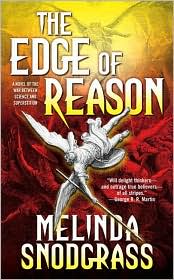
They totally pulled the "lets name the character at the start of each chapter". This didn't bother me at first, but then I was reading the second book in one of Melinda Snodgrass' ongoing series called The Edge of Ruin and lo and behold she did the same thing! This is when it really bothered me though because in the first book Snodgrass didn't do it, she just had normal perspective changes, but book two she started copying Martin, except half assed. You see Snodgrass doesn't really utilize many characters, indeed she has one main character and then occasionally she'll switch to another just to develop the plot. What she ended up doing was only naming the main characters chapters. The character, named Richard, has the main bulk of the book, but all of his chapters start with "Richard", but NONE of the other characters do. So we'll switch to a whole new, different character with no heads up, but then when it's Richards turn we're suddenly pulled back with that crap. Not only does this serve zero purpose, but it was annoying as all hell. Her story is not nearly complex enough to warrant naming the character, nor does it really work all that well when you only have one main character and a host of side characters. 

Both examples come from authors directly associated with Martin so my hope is that it is merely a local trend, but given the success of Martin and now Abrahams and Franck, I would not be surprised if authors, editors, and publishers started leaning toward this style. Authors.. we're not stupid, we don't need and holding, and no matter how complex you think your stories are, we can follow along with the plot. Furthermore, please, please just give the character his due time, don't try and keep it split up, instead if a character needs two, or three, or however many chapters to further the plot, give it to them!

Friday, September 9, 2011

Alastair Reynolds

The man himself!
Alastair Reynolds: Author, Scientist, and one of the best science fiction authors writing today. Perhaps it is a bit premature to call him our generations' Clarke, Heinlein, or Asimov, but I have no doubt that 20 or 30 years down the line, that those are going to be the comparisons being made. Reynolds was born in Wales and earned his Ph.D. in Astronomy from St. Andrews, Scotland. From there he worked for the European Space Agency (Europe's NASA) for 12 years before he decided to pursue writing full time. When you read Reynolds it's certainly easy to think the science and technology of these distant futures is far-fetched or even impossible, but given his background and the amount of research he does for all of his books all of it is based on fact and is more than plausible.

 What type of science fiction does he write you ask? Well, that's a rather difficult question to answer, for several reasons. First and foremost, I believe he is writing in a genre all his own, sure his style is firmly rooted in hard sci-fi, but it's more than that. He has amazing characterization and storytelling, two things that many hard sci-fi authors tend to lack. His books feature grand scope comparable to some of the best space opera out there. Cyberpunk? Absolutely! Steampunk? Damn straight! Both at once? You better believe it! If it sounds hard to believe and near impossible to pull off, you would be right..... except Reynolds does flawlessly. Perhaps now you're realizing the difficulty in using an almost arbitrary system to classify such an eclectic author.
Collection of Reynolds books only missing Terminal World
I discovered Reynolds back in 2007 shortly after I started working at Borders--may it rest in peace. His first book is called Revelation Space and is also the first book in the "Revelation Space Series" which spans thousands of years and includes a main trilogy, following Revelation Space, as well as several full length novels and many short stories. To say that I enjoyed them is an understatement, I read all three novels in the Revelation Space Trilogy, plus one of the full length novels set in the Universe. As I said before (and probably in several other blogs) Reynolds has the amazing ability to pull you into these far flung futures and make it so you cannot stop until suddenly its over. You not only fall in love with the characters, but your heart aches to live in these worlds to experience the next stage of humanity. The Revelation Space Universe is so rich and complex that it is barely a leap of the imagination to believe these places actually exist and even less of a leap to see the plausibility of their future existence. Reynolds is masterful in throwing hundreds of strands in different directions and then, amazingly, being able to tie them all up in a neat package that blows you away in the end. Interestingly, he also knows just which to leave dangling to leave you practically raving to know what happens next. This, I believe, is one of his best strengths as an author. Some authors believe that they need to tell you exactly what happens, how it happens, and what the future will hold for the characters, whereas Reynolds leaves his characters and his stories in a conclusion, yes, but also with a wide open door for what will happen next. This can be amazingly frustrating, naturally, but at the same time I find it almost more satisfying to not know play by play what the "final" end of the characters is. Don't get me wrong and think that he doesn't conclude his stories, because he does, but instead of "and Jack and Jill lived happily ever after to the end of their days" you find that after the story has ended, the rest of this characters life is ahead of them, with the possibility of adventure, tragedy, or even the mundane. The great part is that you don't know. Occasionally a thread from one story is picked up and toyed with in another, sometimes to an ultimate conclusion for that story, other times just to tease and to let the reader know things were happening in the interlude. Call it fan service, but I find it very satisfying to hear a tidbit about "character x" in a completely different story and time.

The Revelation Space Universe
Above are the covers of all seven books and short story collections that are within the Revelation Space Universe. Now, if you google "Revelation Space Reading Order" you'll find tons of different ways to read them, but honestly I would say the best way is to read them by publish date with the exception being Chasm City, which deals with some characters from the main trilogy, but does not make as much sense without having finished the trilogy. Think of it like C.S. Lewis's "Chronicles of Narnia". Sure Book 1 is The Magicians Nephew, but it doesn't make a damn bit of sense unless you've read the other 6! It's not quiet as bad as that, but I enjoyed it more after I had read the main trilogy. I personally recommend this reading order, but there is an actual chronological order that things can be read in, if you're into a stickler about that sorta thing:
  1. Revelation Space (2000)
  2. Redemption Ark (2002)
  3. Absolution Gap (2003)
  4. Chasm City (2001)
  5. Diamond Dogs, Turquoise Days (2003)
  6. Galactic North (2006)
  7. The Prefect (2007)
I do have to say that a lot of the short stories and novellas are harder to appreciate without having read the main trilogy, which is green above. 

Other than the Revelation Space novels, Reynolds also has four non-related novels that are amazing. These I also read by publish date, cause that's just how I roll. 
  • Century Rain (2004)
  • Pushing Ice (2005)
  • House of Suns (2008)
  • Terminal World (2010)
Century Rain has a really neat noir theme, but of course is set in the future.. and the past.. and I gotta say is one of the most unique stories I've ever read. Pushing Ice is some classic hard sci-fi with a great action/adventure twist, and a pinch of space opera that leaves you breathless upon finishing it. House of Suns is probably my favorite of the four and ends in such a way that I am still longing to know what else can/will happen. Again, it is another genre breaker that defies classification. Finally Terminal World, is that crazy mix of steampunk and cyberpunk, not to mention hard sci-fi, space opera, planetary romance, and excellent action and adventure. Hmm well it seems that all four are pretty much unique in terms of classification and I am doing a terrible job of actually making you wanna read them.

If you don't want to jump into the 7 novel universe, I highly recommend picking up one of the four stand-alone's, all of them have the power to blow you away and in all likely hood will interest you enough to picking up his other stuff!

Friday, April 2, 2010

The Shadow of the Wind by Carlos Ruiz Zafón

I know readers, I know, I said I was going to be posting my recommendation blog up next plus a couple other projects, but I got distracted. Not by school or anything silly like that, but by a book, but not just any book, one of the best books I have yet to encounter called The Shadow of the Wind by Carlos Ruiz Zafón. What's even more surprising about this is the fact that this book isn't a science fiction or a fantasy, heck it isn't even a mystery/thriller, this is a Fiction! Not only that, but it's set in the 1940's! How can this be you ask? Well, even though I have my complaints about the fiction/literature as a whole, when a good--no scratch that--great novel comes out, it is my duty to acknowledge it. Indeed, even great may not do this book justice. No, The Shadow of the Wind is easily one of my top ten favorite books ever.

As usual, I was somewhat skeptical of this book when I heard of it, but after hearing recommendations not only from customers I trust, but from one of my coworkers that is as much of a bookworm as me, I relented and decided to but it. I've had The Shadow of the Wind on my 'to read' shelf since mid-December, but it wasn't until recently that I finally picked it up. Let me tell you, dear reader, that as much as I love my sci-fi/fantasy, this book blew me away! I don't know what it is with Spanish and Portuguese authors*, but they just have this poetic way with words that, not only makes reading their books a delight, but adds so much to the plot that it almost makes it hard to read poorly written American prose! Alas, it is actually rather difficult to even quantify this book as just "fiction" because it's so much more! Mystery, romance, tragedy, and suspense! All of them wrapped up into an amazingly poetic tale! The setting, as I mentioned earlier, is the 1940's Barcelona, Spain which adds a whole other dimension to this already epic novel! While reading The Shadow of the Wind, the reader is also taking a tour of historical Spain just after the Spanish Civil War, a time of bloody fighting and terror! The great thing, though, is that the reader need not be a Spanish historian to understand and enjoy the story--this should be obvious seeing as I am about as far from being considered a Spanish historian as I am from being a Olympic figure skater. Indeed, far from turning the average reader off from the historical significance, I believe that the book will intrigue and fascinate everyone to the point of doing a bit of research! I can honestly say that, though I've always wanted to go to Spain, it hasn't been very high up on my list until now. I would give anything right now to hit the streets of Barcelona with a copy of this book! Speaking of which, at the very end of the novel the author includes a walking tour of Barcelona so you can see all the sites described in the book. Though some are, of course, fabricated, I think it would be so cool to wander the streets and see these places that inspired the book! Indeed this type of thing has only recently become stupendously popular with Dan Brown's novels--you can take countless paid tours of The Da Vinci Code and Angels & Demons in Italy and rumor has it that there are The Lost Symbol Tours springing up in D.C. as well.

Alas, the very nature of The Shadow of the Wind makes it extremely difficult to talk much of the plot without giving away spoilers, but suffice to say there are things in this book that surprised even me! I hate to be cryptic, but I refuse to give away anything at all about this book! In any case, this is one of those books that absolutely everyone can and will enjoy from bookworms to the occasional reader, it has something for everyone! Actually I wish I was better read in some of the classic literature that is referenced in The Shadow of the Wind and actually it has inspired me to read my least favorite type of writing, poetry. Hell, this book is almost enough to make me want to learn to, at least, read Spanish so that I could fully absorb it the way it was written! Speaking of which, I have to give major props to the translator Lucia Graves whom without which The Shadow of the Wind would have been a lesser novel. She straddles that insane line of being able to both translate accurately and yet still keep the poetic and well written nature of the book intact! So my friends, please, for me, go to your local bookstore or library and pick up this novel, I promise that you will not be disappointed! And no worries, I'm still working on my other posts which should be out this month, hopefully!

*If you haven't read anything by one of these authors here's three excellent books to try out: The Alchemist by Paulo Coelho, Blindness by José Saramago, and, of course, the one I've raved about in this post, The Shadow of the Wind by Carlos Ruiz Zafón.

Thursday, February 11, 2010

E-Books as a Means to Revolution

In the past I've written about the E-Book Revolution as well as some of my thoughts on owning digital vs physical books. I'm still doing a lot of thinking on the subject and I think I may have come up with a pro for the Revolution.

The publishing industry, like most big businesses these days, is corrupt. There's no doubt about it. You have publishers swindling authors by paying them much less than they deserve, only to turn it around and charge way more than they should, then, on top of that, you have book sellers--both the so called "brick and mortar" as well as online retailers--upping the price again for profit. Of course, the publishing industry is not nearly as far gone as the music industry, or even that of the movie industry, but I feel like it's effects are far more devastating, both to the consumer as well as the author.

I am not an author myself, but working in a bookstore as well as reading author's blogs I feel like I have enough information to make a reasonable opinion of the situation. Authors spend months or years in a creative fever trying to write a book. They have to deal with their own criticisms, writers block, plot holes, and a whole host of other mentally challenging obstacles before the next step. Revision. They revise, revise, and revise again; tweaking, changing, adding before they have finally come up with something they're proud of, I've heard it likened to a child even. So they package it up and send it out to the world and wait, and wait, and wait before.. Rejection. As far as I can tell many authors to hit it big first off, but even if they pass that big hurtle, they're still stuck with "We at *insert publishing company here* are very interested in your book. We'll take a chance on you for $xxx.xx and a publishing run of xxxx copies..." and so on. Now sometimes the author will get the price they were expecting, but many times they're shortchanged, cheated, and robbed. I mean after they have spent so much time, money, and emotional well being on their work and yet the publishing company wants to offer you that much? This is where it can get shitty, if indeed they have put out a written a damn good book, they have been paid x amount of money to get it going, and only get x% of the profits as well, but because the author decided to settle for the publishing companies numbers they'll be getting all the profit. Now generally if the author hit it big they'll offer more for next book and so on, but this is where the major snag comes in because if the author does indeed keep writing those best sellers, publishers expect more books out of them. More than likely the author has to sign a contract stating that they'll write x number of books per year for x amount of money and this kills the creativity. Deadlines, stress, and nagging editors harass them at every turn, and generally the first book they wrote was with all their heart, now they just get things out on paper so they can meet the deadlines.

I've seen it happen, great authors like Nora Roberts, James Patterson, Danielle Steele, and Nelson DeMille just to name a few. Their first books were amazing, fantastic, one of a kind; the publishing company they signed up with saw this potential and dragged them into a binding contract. Now look at them, Patterson and Roberts alone put out 5-6 books a year and guess what? They are what I like to call "cookie cutter plots". Change the city, change the character names, and use the twist you had in your fourth book, and make this character fall in love with this one, and generally leave the plot as is. The reason these books continue to be popular is because consumers want to believe that because these authors were great at one time, then they must have it in them to be so again. Another reason is that once a publishing company finds something that "works" they do not want you to move away from it, the author may put in something more original, but instead of taking that chance again they edit it to look just like your last 8 books. Profit, profit, profit.

Naturally those authors I mentioned are successful and probably have a good deal of money, but do they have as much as they deserve? I don't think so honestly. It's all well and good that the publishing world is a business like any other, but I never have felt that businesses should screw over their employees. Books are especially touchy I think because, after all, none of the people who actually work at the publishing company can actually write worth a damn. So it would make sense to me that the author would be treated like a god, but no. Instead big wigs at the company make tons of money off authors' intellectual creativity and merely toss a sliver of that profit back to the author. They then decide pretty much everything about the book that isn't actual writing, they pick the cover artist, they pick what size to publish it in, they pick how many and how long to publish it, and then they merely ask what the author thinks--usually not so much. I believe that authors can escape this rat race with e-books.

As much as it pains me to see paper books are on their way out. Sure it won't be for a while, it might not even completely happen, but working at a bookstore I've noticed how much our sales have declined yet how much amazons e-book sales have jumped. There is a silver lining here, though, and that is for the authors which in turn will lead to the readers as well. Right now we have the Kindle, the Sony E-Reader, and the Nook out on the market with 50+ more already in development. Now is the time when authors can break away from the greed and the corruption of the publishing companies! So far Sony, Amazon, and B&N are arguing over prices of an e-book, they're also arguing with the publishers about those prices. If you haven't heard already, our dear friends over at Amazon want to monopolize e-books and e-book prices so much so that they pulled all of their books from the major publisher Macmillan over such a dispute. Check out the article over here. This whole incident has other publishers getting a little nervous; as well they should, because why exactly does an author even need a publisher for e-books? Amazons trying to market it so that authors sell their books directly to them, this is a baaaad idea though. What authors should realize from this little dispute is that the power is now in their hands again. Instead of going through a publisher or even an online retail like Amazon, Sony, or Borders, authors now have the chance to sell their own books! This may not seem like much right now, but shit, think about it! James Patterson is an international bestseller, if he were to say hey *insert publisher here* go fuck yourselves I'm going to sell my own books, what could they actually do? They'll probably beg and plead for him to stay, but anyone with business sense would realize that he'd make a much bigger profit from selling them on his own. I mean really, he could hire a freelance editor, and then when he finishes his book why even bother with taking only x amount of the profit when he could put it up on his website and make 100% of the profit. It wouldn't be hard, he'd still sell a ton of books because he could price them as low as he wants and still make a hearty profit, and because he is already a huge international author he wouldn't even need the advertising from the publishing companies--which I believe is their only real use these days.

I know the appeal of a solid book, but I can't help but see the possibility of completely changing the publishing world. Unfortunately, because in print books still make up the largest portion of sales for an author, one or two authors wouldn't be able to accomplish this it has to be a group effort, it has to a bunch of the big name authors coming together and sticking it to the man. You get James Patterson, Nora Roberts, Clive Cussler, Dan Brown, Orson Scott Card, Stephanie Meyer, Stephen King, and a few other big names and the publishing industry would be crippled! Now with that many big names going independent it wouldn't take long for younger more green authors to follow suit, and soon publishing companies will have two options: Completely gut and reorganize their industry or loose buckets and buckets of money, if not go out of business all together. Sure they might fight, but they would have no real cards in their hand, sure they might have the rights to certain books for a certain amount of time, but that won't be enough. People want new books by these authors not the same thing they've already read. How would the new publishing world look? Well for one authors would have complete rights to their books, no "we'll take a chance on you and buy your book from you for x number of years", the publishers get the privilege of putting their name on the book, that way authors can sell paper books in major retailers as well as put their e-books up on their own website for their pure profit. Next authors should get at least 50% of the profits, I know that publishing paper books is not cheap, but it is not so expensive that you can get away with an 80% : 20% publisher : author ratio. This in turn will mean that publishers will have to restructure their prices to be more reasonable in terms of what it costs them to print the book and what they charge for it. Somehow I don't think it costs even $20 a book for hardcovers and yet publishers list the price at $25+ per book. Sadly I can't seem to find any accurate information on how much publishers actually make because of this, but I feel like they can lower the prices of all of the books. This will also mean that instead of keeping a book under hardcover for a full year (or more) will fade away. Most books do not last a full year in hardcover with even decent sales, what they should do is put books up for 3 months, if sales are good, up it to a maximum of 6 months and then send the book to paperback.

The next thing this restructure will do is stop the rampant corruption that has filled the publishing world. Most people don't know, but the New York Times Bestseller List is a load of shit. Yes that's right, a load of shit. Why you ask? Because publishers contact Borders or Barnes and Nobel and say "hey for $xxxx I want you to get everyone in your company to market this book" this is all under the table by the way. I've seen it done. Just looking at the NYT Bestseller list this week 4 of the top 10 are best sellers because of Borders, which may not seem like a lot, but you have to take into account that 4 others are on the list because of their movies. That leaves 2 books that made the top ten because of being well written. 2% that's wretched. Of course it's not always through bookstores that they do this, many publishers send their books to Oprah, hmm I wonder why? Every Single One of her "recommendations" has been number one on the best seller list. Why is this important? Because many, many, many people only buy books if they have a NYT Bestseller stamps on them. They won't look at books that have won actual awards--which you might notice are hardly ever on the NYT list--they won't touch anything but these books because they think that if everyone else is buying it, it must be good. Nope, actually employees at Borders and B&N are told you have to sell this many of this book, and if they don't their hours get cut, which means the store loses money, which means that everyone working at these retailers has become sharks because without hours, no money, no money, no food, no food, death. Furthermore employees actually get in trouble with their management if they don't sell these books. It doesn't matter if the books actually suck, it doesn't matter who the customer is, you have to try your hardest to sell these books even if it's not something even related to what the customers purchase. You could be a big buff biker who only reads hunting books we will still recommend things like Twilight to you. You have to note as well that we booksellers and even the management do not know where the corporate offices pull these books out of their ass, and when we ask they say "oh we just liked it". Right. If they had actually even read the back of these books we're forced to sell they would know that they are not very good, nor do they actually appeal to a wide variety of people, this and the fact that they all hit the NYT list makes me believe publishers have money that isn't accounted for. If the structure was reset, though, publishing companies would have to consult with authors before they do anything with that author's book. Now sure, there are going to be some greedy authors out there, but generally I think authors want to make the List off their own skills, not because a thousand borders around the country are forcing it on hapless customers. Even if it's just a foolish fairytale that's what I believe.

I don't know if it will ever happen, but I think now is the time for something to happen if it will. Authors have to strike against the publishers before they all fall in line together and it becomes practically suicide to market your own books. You wrote the book. You put in the time for it. You sweat blood and tears for your books, take a stand, and take back what is actually yours! Publishers nor book retailers have no write to set the price of your e-book, they aren't doing anything with it in terms of supplies, they may market it a bit, but most authors have a huge following already on their website! It wouldn't even be hard; e-books are merely a text document that you can put up on your website with hardly any cost to yourself. Lastly, you don't want your fans to be screwed do you? We're your life blood, we only put up with publishing companies because of the huge monopoly they have over your works. Now is the time to take matters into your own hands!

Friday, December 4, 2009

Originality

I entered the world of blogging back in 2007, at first with some faithful companions, and then on my own. It was my senior year and I honest to god wanted to become a better writer, express my thoughts more clearly, and put myself out there. It was a rough start to say the least and, honestly, I don't know if it's even gotten that much better for me. I've watched the progress of my friends and, like everything else in my life, they've improved miles while I've gone inches. Or so I think, one thing I've learned over these past few years is that you cannot judge your own writing, at least not so much that it prevents you from doing the thing you're here to do; write. I've had so many difficulties with this idea; in fact I don't believe I've overcome it yet. To date I have never finished a short story or any sort of fiction at all; I've ranted, I've raved, I've peered into my soul at times on this blog, but I still have yet to actually do what I set out to do. I know that very, very few people actually read this blog, and I know that I thrive on those readers, but honestly I'm actually quite terrified of certain kinds of criticism. Sure I don't really give one wit about what others think of me, but when it comes to fiction and short story stuff, I'm terrified. Perhaps it isn't just them I am afraid of; perhaps I'm afraid of what it is I will think. My first and last attempt at any sort of story was Untitled and I came to a very interesting conclusion: I may read too much. I know it sound weird and off—authors need to keep in touch with their genre after all—but I've been thinking about it for the past couple months and I don't know if I have any of my own ideas.

Originality is, after all, an authors best friend, it's what gives him his power, his allure, his greatness, but it's also one of those things that is becoming harder and harder to come by. If you think of great fantasy, Tolkien comes up without a second thought, but really how many other authors are really being as original as they should be? I mean sure a few come to mind, but many of the fantasy authors I can think of have striking similarities to Tolkien, some, like Terry Brooks, blatantly rip him off. Of course many authors are different too, but I find that when I write, or even think of stories playing out in my head, that they are horribly similar to things I've read or seen in the past. Some are completely subconscious to the extent that I don't even realize it isn't even my idea in the first place, others take a mere five minutes of thought for me to realize "shit.. this isn't mine". The easiest example is, of course, Untitled because one of my good friends first pointed it out to me. You see there's this graphic novel called Air Gear that was floating around the net back freshmen maybe sophomore year (it's now available here in the U.S. in hard print), this graphic novel was the inspiration—without my knowing it—of Untitled. From wiki:

"Itsuki "Ikki" Minami, is a student and a delinquent. Also known as the "Unbeatable Babyface", Ikki is the leader of the youth gang by the name of "East Side Gunz". Upon his return home, after being humiliated by a Storm Rider team called the Skull Saders, Ikki discovers a secret hidden from him by his benefactors, the Noyamano sisters. The sisters belong to a group of Storm Riders who go by the team name of Sleeping Forest. In the anime, learning the sisters' secret angers him and he steals a pair of Air Trecks, abbreviated as "AT". (In the manga, the sisters give a pair of ATs to him and invite him to skate with them.) Ikki eventually settles his grudge with the Skull Saders, but in the process he receives more than the simple satisfaction of revenge. Determined to experience the sensation of "flight" for as long as he can, Ikki is quickly engaged in the mysterious, irresistible world of Air Treks."

Yeah, you might not be able to tell too much how similar my story was, but trust me, it was. Sure I had different names, a different setting, and a slightly different premise, but at the heart it was Air Gear written poorly. This may be part of the reason I stopped, subconsciously I knew I was kind of ripping off this story, but who knows. Recently I have had a million ideas running through my head, stories to tell, characters to create, but I am afraid of ripping things off again. This is partly why you have an editor I'm sure, partly why you keep in touch with what others are doing, but honestly, can I really say that I have any of my own ideas? I look over at my bookcase and there are so many stories there, so many characters, plots, and worlds, can I really write something on my own? There are book I read back in middle school that I don't even remember, probably books from my childhood that are gone, but memory never really disappears, we just loose access to it. Already I scoff at professional, excellent writers because I see similarities to others, who am I to even judge? I know that people get inspiration from others, every author interview says as much, but where can you draw the line? Some, like Lev Grossman, make it obvious enough that they're writing satire that it's okay to use such fundamental ideas, but others, like Brooks, seem to not know or not care that their story is the same give or take a character name. I wonder if maybe I just need to write without thinking and get it out of my system. Perhaps I'm over reacting and just need to get my foot in the door because I have not written anything to completion. Maybe writing something, finishing it, even if I don't show anyone, is the way to go, I mean if it is blatantly ripped off from somewhere who cares? Yet I feel as though everyone else out there can write amazing, original, creative works on their first try. So many of my heroes wrote their first book or story, got it published, and were on their way. They had a well of ideas that never seemed to end, and yet the first thing I try and seriously write is plagiarized trash. Now look at me, I read, and then write about books, that is all this blog has turned into. Sure it's interesting, but it is not what I wanted after two years of this. Even if it was, I see no improvement between April 2007 and now. My vocabulary may be somewhat more sophisticated, but not much, and certainly not as a result of me writing about fucking books. I mean I don't even do that "right", I ramble and I jump around, and in the end I just have a big puddle of mush that probably turns people off from the books more than interests them. What do I do? I know I have ideas, but how can I know they're mine?

Maybe that's the thing; maybe everything really is just a copy of a copy of a copy. Is there even such thing as true originality? Or are things only original because we have yet to have encountered them before? Tolkien could have knicked some of his ideas off someone before him, and that person from someone before. Back in the early 1900's Carl Jung—one of Freud's disciples—was examining patients in a mental hospital when he encountered a severely schizophrenic man gazing out the window in a peculiar way. When he asked the man what he saw the patient told him that if he squinted his eyes and looked at the sun, he could then see the "sun's penis", and that if you moved your head to and fro you could see the penis moving and this, he said, was the origin of the wind. Pretty fucking weird eh? Well, it wasn't the first time that had been said. It turned out that when Jung was studying mythology he came across a recently translated Greek text that said nearly the same thing: a tube hanging from the sun, when moving, caused the winds. Penis aside, there was no possible way for this schizophrenic man to have even heard of the text since it wasn't even translated until after he had been committed, from that encounter Jung developed his idea of the collective unconscious. As the name implies, Jung believed that every human being had access to this vast store of knowledge and could not be explained by personal unconscious from ones memories. Things like God, the spirit, truth, justice, these things aren't learned even over an entire person's lifetime, yet even a young child knows when something is just "wrong", he may not know what that thing is, why it feels that way, or be able to explain it, but he just knows it. Certainly we learn things, from our parents, society, and many other things, but there's something else going on. This is one of the topics that was addressed in The Witch in the Waiting Room by Robert Bobrow M.D., and one of the things that I feel we have yet to truly unlock. Even Plato believed in this with his Forms which "asserts that non-material abstract (but substantial) forms (or ideas), and not the material world of change known to us through sensation, possess the highest and most fundamental kind of reality". Essentially anyone can look at a chair, any chair, and know that it is a chair. I'm not a philosopher so I probably botched the metaphor a bit, but the idea is the same. Why is it that in fiction there is always a hero and always a villain? Even the oldest written human stories contain these ideas: in Homer's works and even in the ancient, ancient Epic of Gilgamesh contain these very same themes. Certainly there isn't The Lord of the Rings just floating up around, but the idea of it is there, Good over Evil, Light vs. Dark, Friendship and Loyalty, it's hard for me to believe that these things, which are all so prevalent in every culture, are just things we learn. They're too profound, they're too intense. Even just the idea of "friends" is too much for anyone to come up with on their own, and yet at the youngest of ages we group together, we are loyal to one another, we make these connections with other people that just cannot be explained. And then there's love. Countless songs, ballads, poems, and every other kind of expressive form have described this. Across generations, throughout the world, love is another one of those forces that every human just knows deep down.

Perhaps originality is merely taking these ideals and putting your own face on them, certainly we enjoy authors like Tolkien and Herbert not only for their ideas, but for their characterizations, their subtle twists and turns. It's a cliché by now, but it really isn't the destination that really counts, it's the journey to get there! That's kind of where I hit a rut, I'm so paranoid about ripping ideas off, that I can't appreciate my own unique ride. I do truly feel that reading is almost detrimental to my writing, but at the same time imitation is the highest form of flattery—unless you're a lawyer. I said back in the day that the only way to improve one's writing was to write, I think the same is true for fiction, your first few stories might be horribly familiar, but it might only be because you're most familiar with other peoples writing and haven't yet learned what your own style is. Write now I really do not know what my style is, at least not in a fictional sense. I know I ramble when I write, but that is because of my lack of proofreading or editing. It's horrible, but I have never proofread my stuff before, I generally write, and post (or turn in as the case may be). As such I've realized that proofreading is a skill, a skill that is hard, frustrating, and makes me want to shoot myself, but a skill none the less. As all skills go it's another one of those things that you just have to do over, and over, and over again before you can really do it decently. For someone such as myself it is also one of those skills that is absolutely essential, my grammar sucks, I ramble, my sentences are awkward, and I generally take forever to make a single point, so bear with me. This is one of those things that I am going to try and do from now on, on all of my posts. Except this one, it's 12:30, I'm tired, and I really don't want to look at this post ever again!

Wednesday, September 16, 2009

On the Science Fiction / Fantasy Series

In my last post I spoke briefly about too much story, but what does that mean exactly? Well I've been thinking about this for a while now and I've decided that generally speaking for an author to fully accomplish a sci-fi or fantasy story, it needs to be part of a series. What kind of series you say? Well that depends largely on the authors story, but I think as a very general--there are plenty of exceptions--rule it is safe to say a trilogy works best of all.

The Trilogy

The idea of a trilogy has been around ages and ages in the fantasy world, but it didn't really hit home until Tolkien. The Lord of the Rings is perhaps one of the best series in all of fiction, which includes the silly "Literature" category with Steinbeck, Hawthorn, and other such "Literature" authors. The reason a trilogy works far better in a science fiction or fantasy series is because the author must create an entire world with its very own unique histories, languages, kingdoms, and other such fascinating things. In a "literature" book the hardest part of writing is practically done for you! All you have to do is say "it was 1945, Germany had just fallen! Jake, the onetime Nazi hot shot, is on the run." BAM! That's the entire setting you need to talk about. Sure, you'll talk about the scenery, maybe a sunset here, a dog there, but really everyone knows what earth is like, everyone knows what happened in WWII, everyone knows Germany is in Europe and Europe is across the ocean from the United States. What exactly is there for you to create? A plot, sure, but that's all you're going to be doing; developing characters, developing a plot, and throwing a twist now and then. Sure there are some amazing novels out there that are like this, but my point is that it's easier than creating a whole world of different races, histories, and evil. This is one of the reasons classic literature, like Steinbeck, cannot be compared to any sort of science fiction or fantasy book. Not that they're both hard to write, which they are in their own ways, but the differences make it impossible to even look at the pros and cons of each style. No one will disagree if you say Tolkien was a fantastic author, but it's when you try and compare Tolkien and Steinbeck that you run into problems. This creation of a setting is what makes a trilogy the best for science fiction and fantasy.

Hubbards problem was he tried too hard to fit absolutely everything into one book. Some people can do it, Elantris by Brandon Sanderson is an excellent self contained novel, but others are just too ambitions. The first book in a trilogy sets the tone, it gives the reader a chance to stick his toes into the water, get acquainted with just where they are. The author generally introduces the setting by giving a history of the world/universe, introduces the main characters and their own personal histories within the major world history, and introduces the plot. It doesn't seem like much, but it's a lot more than you realize. Personally I love knowing the ins and outs of this fantasy world; its government, economics, wars, races, languages, and all that other stuff that is generally taken for granted in literature. In order to do this you cannot write it like a history book, people don't like to read textbooks, the best way is to do this in bits and pieces. I've found that a prologue does the job quite well, you're introduced to the land and its history, and then to the main character. From there the author will usually jump through time and into the present (for that character) and as the character goes on his journey/quest/voyage we learn more about the world as we go along. Sadly this makes for a perfect cliché because the easiest way to give the maximum amount of information through the characters journey is to have the character from a small town. Yeah, this has lead to the farm boy, fisherman, hobbit, or generally "innocent" character finding his way through the big, scary, complex world through interaction. It's really not a bad way to go in my opinion, but it certainly gets old after a while.

After the author has done all his introductions and sent his character on his quest it is time for the sequel. The sequel or middle book in a trilogy is generally, at least in my opinion, the driest of the three because it's all plot/character development.
LotR: The Two Towers
,
Shadows Edge, The Ring, and
Redemption Ark
are but a few examples of sequel books that don't live up to the trilogies as a whole. The reason for this stems from the fact that as the middle book they have a lot to live up to and yet have less interesting things to talk about. From my experiences the middle child of a trilogy is mainly there to bulk up the plot, enhance the character and world histories, and lead up to a stunning conclusion. Because of this they never get the chance to really shine! By this point in writing an author generally knows it's going to be a trilogy and so immediately they're jumping to the conclusion in their heads, but are stopped by the fact they have a lot of plot and build up to do. Don't get me wrong, there are some absolutely amazing sequel books out there--Green Mars, and pretty much all of Raymond E. Feists trilogies are solid the whole way through--but a lot of times the author just gets ahead of themselves and doesn't put as much effort into the second book as they do in the first or third.

As for the third, well, that's where the magic happens.. usually. By this point in the series you're in love with the characters, the world, and the plot, you're just begging the author to finish up and tie up all those loose ends to form a fantastic ending. Well 9 times out of 10 they deliver. My theory is this; all the good books out there aren't written for the fans, for the author's wife, for anyone, all the very best works are written for the author. This usually means that the last book is a work of pure genius! As much as we the reader feel attached to the story and want it to go on, the author is a million times more into it and that translates right into the book. Where they were hesitant in the first, clearing up details in the second, they are letting loose with their creative talent in the final chapter of their trilogy. Just look at some of them out there, Return of the King (obviously), Absolution Gap, and Beyond the Shadows are all fantastic! Unfortunately, because the author is a lot of times writing for his or herself, the fans can be let down by this third novel. In as much as they want us to be happy, they want to be happy, and generally--especially with high profile undertakings--the conclusions sought by the fans, are not what the author delivers. Sure they'll deliver an epic, a masterpiece; a piece of art, but sometimes the execution isn't all that it should be. Harry Potter and the Deathly Hollows is, even though it's not a trilogy, a more than perfect example. In fact, I would wager to say that the ending to that book almost ruined the entire series for me. This is partly due to hype, popularity, and poor writing style. It's a sad fact that really shitty books tend to be best sellers, and let's face it J.K. Rowling is not the best author out there, so even though she created a cult phenomenon, she didn't have the experience to finish it off properly and the whole series suffered for it. This happens a lot with novice authors, but hey you have to get out there sometime, you gotta write that book, and you gotta just suck up the bad reviews because there's always a critic out there. In any case, the third and final book in a trilogy is where the real fireworks are; by this point the author has established enough of a setting that they can throw the reader on twists and turns and betrayals, which usually leads to epic books!

This is why, in my humble opinion, a trilogy is by far the best formula for a science fiction or fantasy story.

~~~~~~~~~~~~~~~~~~~~~~~~~~~~~~~~~~~~~~~~~~~~~~~~~~~

A Side Note

Even as I wrote that last sentence I knew I wasn't done with this post. Indeed, I have to mention that although I do really think the trilogy is the best means to achieve a fantasies creative end, there are other ways. First of all it is possible, like I mentioned, to write a fully self contained fantasy novel, hey, you can write a damn good one even, but it takes a lot of skill some authors don't have. Along the same lines you can write a stunning duology, which also takes a great deal of skill, but allows for more room to play. Karen Miller's Kingmaker Kingbreaker duology is the best example I can come up with off the top of my head. I was a little worried at first, this was her first step into the non-licensed fantasy world (she's written a couple books in the Star Wars Universe) and as such I wasn't sure if she could pull it off. Oh how she did! It has just the right amount of world, religion, and character building for the reader to completely become immersed in and on top of that she has a damn good plot. Sadly the duology isn't a very popular media for authors, I think because they get so into it that they end up with a trilogy, but when it's done well I think it can rival that of a trilogy in some aspects. Those generally tend to be if you're writing a less complex world/story than that of LotR, smaller map, fewer characters/races, smaller timescale as a whole, which can be refreshing. As much as a love the appendices of LotR, sometimes it's nice to relax in a less complex world. Of course you can always go bigger with a quartet or even a quintet, but then you're moving into the realm of an epic.

~~~~~~~~~~~~~~~~~~~~~~~~~~~~~~~~~~~~~~~~~~~~~~~~~~~

On Epics

So your story is too deep for a novel, duology, or a trilogy huh? Well then my friend, you're writing an epic! We've all seen them, we all love them, the epic series are those that flow through multiple volumes over multiple time frames. Think Frank Herbert, Raymond E. Feist, Terry Goodkind, Robert Jordan, and George R.R. Martin, these are the big wigs. These are the ones that will blow your mind over and over and over again, that will keep people talking for years, these are the ones that go down in the history books! Naturally there is a higher degree of error here, Terry Goodkind lost it toward the end by injecting his story with Ayn Rands philosophy, Robert Jordan died, and Martin, well Martin just won't release the next book in the series. But hey, all that aside, and these are some of the best books out there. The interesting thing I find with these is that although the worlds are that much more detailed than trilogies and the other forms, they aren't as detailed as one would expect, usually these epics are super plot heavy or, on the contrary, follow several different plots all in the same universe. The Enderverse is an amazing combination of both, Orson Scott Card delivers an amazingly detailed complex plot over several books, and then flawlessly jumps thousands of years and yet still keeps the magic. Herbert did the same with the Dune series, writing a fantastic plot before jumping thousands of years and pulling out a new plot tied to the old. *sigh* Dune is just the definition of epic--not the silly gamer definition either--but the old school Odyssey epic!

Perhaps my favorite form of epic is that of an established universe with many branches. Think of it this way, you have a trilogy that makes up the trunk of a tree--we're talking redwood trunk here--that establishes this stunning universe with hundreds of thousands of story possibilities, and then the author ads some creative water and BAM! You have on your hands a tree so full of stories, characters, love, and grief that it almost brings a tear to your eye. This is my favorite style of fantasy/science fiction because you fall in love with the main trilogy, the main universe, the main characters, but instead of dragging on the plot *cough GOODKIND cough*, they end their trilogy and branch off in their newly formed realm. Isaac Asimov did this, though I've only read the Foundation trilogy, to an extent Tolkien did this with his follow up books The Silmarillion, The Unfinished Tales and other such works*, but the two authors that have done this the best are Raymond E. Feist and Alastair Reynolds.

Feist is an interesting case, his series is based off that of a single duology, though first published as one novel, and then proceeds to follow the main characters and the main characters children, and then their children. All the while keeping a few of what I like to call uber-characters throughout the entire time span. Pug, Tomas, and Marcos the Black all make appearances in the books even though they're set decades in the future. This may sound silly, but it's explained perfectly, don't trust me go read it! But the best part is how Feist incorporates the stories of his first books and turns them into legends in the later books. Battles you read in the first books all morph into something more as the years go by, mere mortal characters become god-like kings, and villains turn into the stories used to scare kids at night. I can't even give do justice to Feist, all I can say for sure is that you need to read it! Fantasy

Reynolds, on the other hand, is more of the tree-like epic writer I mentioned earlier. His Revelation Space Trilogy is by far one of the most amazing things I have ever read and it only gets better! Included in that one, because it falls under the same time-line ish, is Chasm City a standalone novel that introduced me to this style of writing; basically what Reynolds did was create this fantastic universe (and I do mean universe literally), write a jaw dropping trilogy in that universe, and then proceed to write other stories, novels, and novellas within that universe. All the while Reynolds is developing and changing and enhancing this universe to the point that if he wanted to, he could only write books set there for the rest of his life and never run out of stories. I really didn't even realize the scope of this until I picked up Galactic North which is a collection of eight short stories and novellas, all independent and utterly amazing within their own right. Shortly after that I picked up Diamond Dogs Turquoise Rain, two novellas that completely blew my mind! And since then I've read four or five of his short stories within sci-fi anthologies! The possibilities are endless for this series and like Feist, some of the things you witnessed in the original trilogy turn up again in fan pleasing ways!


~~~~~~~~~~~~~~~~~~~~~~~~~~~~~~~~~~~~~~~~~~~~~~~~~~~


You know I set out to kind of outline my favorite style of sci-fi/fantasy, but it turns out I can't narrow it down. I adore Herbert, Feist, and Reynolds for their epic masterpieces, but at the same time Tolkien will always have a special place in my heart with The Hobbit and The Lord of the Rings, and even smaller than that I've read countless novels and short stories that will always be remembered as fantastic. It really all comes down to the story in the end. Some are just meant to be many books, others are meant to be a 20 page short story, but all of them—with a few exceptions of course—are amazing. It's true, just looking at my bookcase I obviously prefer longer story arcs than shorter ones, but I think part of the reason is because I've been lucky enough to read only the best of the best! I know people that have read a longer story arc, hated it, and will never pick up anything more than a trilogy, but I also know people that refuse to read anything other than the super long stories. Each style has its own pros and cons, its ups and downs, it's good and bad, but hey, that's what makes sci-fi/fantasy such a dynamic genre! Nowhere else can you find such a wide range of reading options as in the sci-fi/fantasy realm, indeed nowhere else will you find all in one place more worlds, universes, and characters than a trip into the sci-fi/fantasy section. I love literature, I love mystery/thriller, and I'm enjoying non-fiction more and more, but nothing will be as close to my heart as science fiction and fantasy are.

Wednesday, August 26, 2009

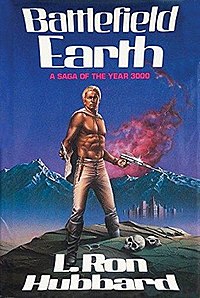
Battlefield Earth by L. Ron Hubbard

Wow, I don't even know where to begin on this one. First let me say that I think Scientology is a load of crap, the same goes with Hubbard, but in any event, his book isn't terrible. It was entertaining, though a bit dry here and there, but overall worth the two bucks I paid for it used. I going to go ahead and avoid saying anything about Scientology and Hubbards non-science fiction life. There is more than enough to talk about with his whopping 1050 page book, so let's get to it.


First and foremost I believe that you have to be very pompous and pretentious in order to write a book that is over a thousand pages. There is just too much story for one book. Period. No matter how good you are at writing, no matter how good you think you may be at storytelling, you cannot write a satisfactory story that is over a thousand pages. You just can't. There is just too much story and by not splitting it up into a sequel or trilogy, you lose valuable plot and world building options. This is exactly what happened with Battlefield Earth. Hubbard is a decent author, he had an interesting concept, fairly well developed characters, and a plot that was readable, but he had too much! Because he thought he was such a great author and could fit all of his story into one volume he actually lost some of the most interesting parts. It might be that Hubbard just didn't have the skill to develop his universe as much as I imagined with the details he gave me, but I think had he sucked it up and split Battlefield Earth into three parts, hell even two, the whole thing would have been way better.

While I was reading I found his ideas, his history, and his overall setting fascinating, but, unfortunately, he didn't develop any of them nearly as well as he should have. His setting is that of Earth in the year 3000 who has been dominated by a vicious beings called Psychols. Who are these creatures? Why are they so horrible? What is their culture? Sadly Hubbard merely touches on these questions about 800 pages in. 800 pages before we know even a bit of these creatures. Sure it fit the plot, he probably couldn't have explained much about them earlier in the book, but the fact remains that he should have told us more! He introduces some 17 different universes, with hundreds of thousands of different races, all ruled over by these Psycholos. And of course he barely tells us about maybe 12 of those races, really he just mentions their name and what universe they're from. Unfortunately he doesn't really go into any real detail about anything! The entire book is just kinda brushing the histories of all these characters, a couple sentences here about the Russians, a few sentences there about the Scots, but never really much. Okay so the earth was practically wiped out a thousand years past, so perhaps the humans don't have much of a history, but if you're going make your setting as huge as 17 universes, you need to talk about them. The worst part of all this is that he was capable of telling such a compelling story, of including his audience in on what only he is privy to, but he didn't.

As I was reading a bit of my bias did bog down some of my enjoyment, mainly how hypocritical he is. A major plot that takes place in his book is that of money, corruption, and greed, yet when he died in 1986 he was worth 200 million dollars. Sure that may not be a huge sum today, what with Bill Gates and all the other tech, oil, and business giants out there, but 200 million back in 1986 is ridiculous! Really who am I to talk, I'm a hypocrite in many ways, as we all are whether we like it or not, but if you're going to create a "religion" based on money and then preach about how awful and horrible money is in your books, well, that's just too far for me!

The other feeling I got while reading Battlefield Earth was that of disbelief. I know, I know, sci-fi/fantasy stuff is suppose to be not real and what not. I know this intrinsically since these are my two favorite genres, but I do expect some realistic elements to be in a book. For example Hubbard made a big deal about how primitive and uneducated the humans were, but yet somehow they manage to learn all the nuclear technology that is left over from their past, electronics, chemistry, physics, ultra high level math, not to mention an alien language, alien math, and alien physics and chemistry. They then use all this information they masted in the space of months to annihilate an alien culture that has been ruling multiple universes for billions of years, where as millions if not billions of other, far more technologically advanced species, tried and failed to do just that. Oh yeah, and apparently they learned all there is to know about math, teleportation, and physics just watching one of the Psycholos do a series of equations for one device. As much as I love the surreal, this got annoying fast. I love strong, clever characters, but there comes a point where they stop being someone you can relate to and become super human plus seem to have the best luck in the world. I cant even count the number of times I've shaken my head at the improbable nature of some characters luck. "Jonnie bent down and at that moment the net flew right over his head" yeah, okay, no the world does not operate like that, at least not multiple times. Sure bad things happened to the characters, but supremely, unbelievable good things also happened that just scream THIS ISN'T REAL! Meh, none of it's real, but still, if you're going to go out on a limb and make up creatures at least have the decency to keep humans, and human nature the same unless you have the prowess to explain why they're so much better than we currently are. In Alastair Reynolds series he has a several human subgroups, all of which have their own unique advantages and disadvantages, not only that, but he tells us how and why his beings came to be that way. No such explanation from Hubbard. To be perfectly honest I don't think it would have been so bad had the book not been so long, I mean I can handle amazing luck and abilities for about 400-500 pages before it just gets old. I think the timescale also plays a big role, Hubbards book is all in maybe 4 years? If that. Not day by day either, skipping weeks, months, and season quite easily, so it was just like today this happened then a couple months later this happens, and then this, and on and on with the dumb luck and abilities.

Oh well, like I said earlier, if nothing else Battlefield Earth was well written, with a neat plot, and decent characters. Overall it was enjoyable, but I know for a fact had he split it up it could have been 10 times as successful as it was. As for recommending this, ehh, sci-fi nerds might get a kick out of it, but unless it's your genre of choice I'd steer clear. If you're looking to hit that 1000 page mark just to say you did, I would go with The Count of Monte Cristo by Alexandre Dumas, or another literary classic. You'll get more out of it, you'll enjoy it more, and you won't have to deal with annoying characters.

Wednesday, July 29, 2009

On Keeping a Journal

I began my summer school at cnm not knowing what was ahead of me. Would my teachers be nice? Would they be worth the time, the effort, the money? Or would it be just another semester of uninspired professors and equally uninspired students. English 102 is one of those core classes that everyone must take. This often leads to a certain amount of blah, a lack luster class full of busy work on things you already know or things you don't really want to know. Even still it is also one of those classes that needs to be taken by everyone, like math, English is one of those subject you build up on, and until you have the basics down, you're nothing more than mediocre. Indeed, even after taking the class you are more than likely going to still be mediocre, but the things you learn in such a class are valuable. A review of grammar, spelling, and most importantly a higher level or writing. Higher expectations. A higher degree of analysis. Deeper, more complex stories and plots. Unfortunately this is something you need to be guided on. You need a good teacher in order to get the most out of a class, especially one like English. My 101 professor, for example, was pretty bored with the whole thing. He was being forced to teach the intro class because there weren't more than a few high level poetry classes available to teach. And it showed. I went through that class with a minimal amount of effort, I don't even remember the essays I wrote, much less the stories from them. Essentially the teacher didn't want to be there any more than the students.

This summer however I was put into a situation where the professor cared a lot about his class and his subject. He had a PhD in English, was a journalist for the majority of his career, and genuinely cared about his students. In other words, I actually had to put effort into the class. The very first day he did something unexpected, one of our major assignments was to keep a journal throughout the summer. In order to make sure that we were keeping it we would have to turn it in every time we did a rough draft of an essay in class. This surprised me because I hadn't ever encountered a professor that gave us an assignment not just for busy work, but for our own, 100%, improvement. I started this blog because I believe the more you write, the better you become at writing. It's been iffy, but I do feel like I've improved somewhat. I can express myself better than when I started, I think anyway, I can put my thoughts down onto paper--so to speak--with more ease, and if nothing else my brain isn't as cluttered as before. This ideal was his as well, but instead of a blog, it was a journal. There was no page requirement, no topics given, it was completely up to us to put whatever we wanted down. Now I've had my fair share of experiences with journals, none of them have lasted, so I was somewhat skeptical of the whole thing. This is because I have always had in my mind that a journal was a daily log of what you did, I'm sorry, but that is horribly boring to me. My life is nothing special, I don't do anything fascinating enough day-to-day to put down, nor am I introspective enough to be able to analyze my day-to-day existence in any sort of self improvement way. So I thought about it, and thought about it, and finally shrugged, I would write what I would write. I wasn't going to put the date, I wasn't going to put what I did, I was just going to write. It essentially became another blog, but with no standards. Even though I knew he was going to read it, I didn't feel the need to make it as polished and complete or even as coherent as my blog is. In fact, it was rather strange, but the reason I didn't keep up with my journals previously is because I find the idea of reading my own stuff boring, I need an audience, I am and always will be an attention whore. What is this blog? It is of no importance, I have few readers, but those that do read drive me to keep writing. It may be a sad reason to write, but it's true, I'm an attention whore. I need people to read my writing even if they don't agree, I need them to validate me and make it so I'm "worth" something, even when I know I am not. That is exactly what happened with this school journal. I wrote and wrote and wrote, not because I had any real interest in it, not because I believe I will ever go back and read it, but because deep down I knew that this professor was going to read it.

The sentences spilled out, the paragraphs formed, the entries added up, and the pages flew by and you know what? I enjoy it. I think that it has even become something of a habit, albeit a rather random one. I don't write in it every day, I never planned to, but about once a week I'll sit down with it and just write. I don't feel restrained by the idea that someone is going to read it, because really even if they do they can't really comment, even if they do it's just a note here or there, whereas here every word and entry is criticized and analyzed by people. I think its a good thing for someone's writing to be torn apart, it helps improve it, and gives the author an idea of what they need to do to become better. But I have found that with a journal I can write merely to write. I've said here in the past that I write only to write and I don't care what people think, and that's true, to an extent. With a journal I've found that I can put anything down, no matter how absurd, incomplete, or random. It's rather refreshing to be honest. An essay is written to be torn apart by your professor, just as this blog is written to express my opinion and let others respond, but a journal is just for me. It's a place I can write about the stupidest or most profound things, and it has actually inspired some of these blog entries. It's like a rough draft for here, and if it doesn't make the cut, what the hell I still got it on paper; I still got the experience from the very act of writing. It doesn't all have to make it here, indeed, a lot of it is just getting my thoughts straight about my ideas, and I think it may actually help my writing not be so jumpy. I tend to figure things out as I write and that makes it difficult to follow from a readers point of view, but with my journal, if I have an idea or thought about something I can write it, expand it, change it all I want and then when I come here to actually express my thoughts they're more thought out.

As you can probably tell this isn't one of those that came from my journal, but hell writing by hand is also really, really hard. I find that with my sloppy handwriting two pages is maybe a page typed up. It's a slow, tedious process, but it's actually enjoyable. I also have the selfish idea in my head that, like some great authors, in the distant future my journal may even be published. It's silly, I know that, but I also feel that this blog may even be published! We'll see what happens! Besides you never know, something like this may actually be popular, I don't know why, but people are strange creatures.

Friday, July 3, 2009

The Edge of Reason by Melinda Snodgrass

Since my "to read" bookshelf has 16 titles I don't honestly know why I keep buying books. It's an addiction, it has to be! In any case even though I knew I had all those titles on my shelf I still wondered into Page One with a couple bucks in cash. It's to the point that I know what I want to read, but don't want to start it because it's a series. I have all sorts of series to read already so I really don't want to start another one, well that's not true, I do want to start them all of them, but the fact is I don't have time to read them! So I go in, meander about for 20 minutes before heading to the little counter for help--I know me a worker at my own bookstore needing help. So I ask the guy there who was the person that knew the most about sci-fi/fantasy--it turns out it was him--and ask him the most difficult question I get asked: "I need a great fantasy or sci-fi that is a single novel, not a series, not stand alone in a universe, but a single fully contained novel." Trust me on this, this question is a whore and loaded to all hell because everyone knows the best aspects of sci-fi/fantasy are their epic series, see Tolkien, Goodkind, Herbert, and Feist just to name a few. His face betrays exactly what I said above in a grimace, I can't blame him, but then I added the fact that I've read a whole hell of a lot already so it might be tougher than usual. We headed over to the section and as we walked he tossed a couple no brainers at me: Crichton, Bradbury, Heinlein, and Dick. All the ones he mentioned I had read save for a Phillip K. Dick whom I was not in the mood for. Then he asked a question that threw me off "how do you feel about religion?" Whew that was one thing I didn't expect at all! I shrug and give him the most non-offensive answer I could while still being true with myself "Eh I'm not a fan, it's all kinda a joke to me." Again this guy throws me off and he laughs and says "I've got a book you have to read!" Here I was thinking he was gonna set me up with a religious themed fantasy--gag--instead he shows me a local author named Melinda Snodgrass who just came out with a new book called The Edge of Reason.
The quote on the cover from George R.R. Martin reads:
"Will delight thinkers--and outrage true believers--of all stripes"

He tells me, basically, that she bashes every major world religion AND governments. Say no more my friend, say no more! Unfortunately for them it was new so I decided to hold off and pick it up with my discount at my work, but in the meantime another guy overhears us who was on break and brings up L. Ron Hubbards book Battlefield Earth. Yikes, Hubbard, really? Whole load of crazy right there. They both assure me that this one was pre-psycho lets start a religion Hubbard and I also remembered that my uncle read most of his pre-crazy books as well and like them, so for 2 bucks I picked it up. I haven't started it yet, but it should be.. an interesting experience to say the least. Hopefully I can keep my bias out of it and just try and enjoy it as a good piece of sci-fi. I'll let you guys know.

So crazy cult leaders aside, this book was amazingly entertaining! Before I go into the plot and symbolism's of the book I have to get some dumb things out of the way. Now I have no right to criticize anyone on their writing, grammar, or mechanics since I suck horribly at all three, but as a reader I have certain expectations of the authors I read. I expect that, as a professional, you won't have too many silly typos/misspellings, I expect that if this isn't your first book that your plots aren't as see through as a third graders, and I expect that your sentence structure and syntax are much more complex than that of a middle schooler. Ms. Snodgrass does a good job with most of the stuff, but I felt myself getting distracted by a rather way of talking. It wasn't horribly confusing just a couple points needed to be re-read so I was comfortable with what I read, there were some silly mistakes here and there, probably due to her editor being lazy over her, and the biggest down to her book was the fact that she kinda gave everything away within the first 100 pages. The grammar and poor editing aside, seeing an author tell all about a plot and the characters so early in a book is a major turn off. There were a couple surprises in the end, and obviously this one is a start of a series so the end itself was rather eh. By the way I took this book because the rest of the series isn't out so I have time to read my other stuff! Generally though aside from some flattish characters--whom I expect will be developed more further in the series--and a plot given away like a drunk virgin, it was a good book.

Like I've said before I'm not going to write a book report for you guys, if you're intrigued by it go pick it up! The thing that made me the happiest was the fact that she grouped ALL of the religious together, she wasn't picking on one over the other, she came right out and said that the entire idea of religions is stupid. Not only that, she made religion and their "gods" into evil creatures using superstition and stagnation to enslave mankind. Indeed one of the major characters is named Cross and he's guess who? Jesus Christ! But really he's a powerful "old one" whom has been converted to the side of reason and logic. The kickass thing about Cross that Ms. Snodgrass uses to attack religions even more is this: He's a schizophrenic! That's right, he's been here since we evolved and based on the cultural view of wherever he is he becomes either Jesus for Christians, Yehoshua
for the Jews, and Allah for the Muslims. So not only are these stupid religious people fighting each other under THE SAME GOD, but they're being controlled and enslaved by every "god" throughout human history. She addresses one of the major things I have a problem with in Christianity which is the fact that in the Old Testament God was an asshole. He killed us, punished us, made us suffer, and overall enjoyed it, this is, she explains, because that's how these creatures thrive ff human suffering. Until one of the other major characters comes in and changes the view of a spiteful angry god into that one of compassion these creatures used holy wars and all those awful things that happened to become stronger. Christians always tend to play off those atrocities as God "testing us", but in reality they were doing it for their own pleasure. Oh man she did it so eloquently and so masterfully that I totally let most of her almost poor writing go and gave her a 7/10 on my list. Another theme that played a smaller role in the book was that of corruption and how if you have enough money you could be the most evil, vile person on the world and get away with anything. It also addressed aspects of homophobia, race, and family.

If you're iffy on religion or hell even if you are religious I think it's a great book to pick up! She's a lot meaner than, say, Christopher Moore's Lamb, but there are things Snodgrass brings up that need to be addressed. Hell it got a good review by the great George R.R. Martin that alone should compel any fantasy fan to pick this up!