Friday, November 13, 2009

Reading Dilemma

It seems that I do my best thinking in the scant minutes before I a fall asleep; that in between place where you are neither awake nor asleep. Generally I find that I think of something amazing, but the next morning it's gone, but this past night I found that I actually remembered some of my thoughts. Actually it may just be that I've thought on this problem for a while now, either way, it comes down to whether or not it's worth the time to re-read books/series again or not.

There are a lot of pros and cons for each, but honestly I find myself stuck. I've read a lot of amazing books and series before, many of which are worth reading multiple times, but yet it comes down to being overwhelmed by the options. Working in a book store really opens your eyes to all thats out there, sure intellectually I always knew there were lots and lots of books, but seeing the thousands of titles that come out over the months really gets to you. So the choice is this, do I fall back and read what I know is good? Or do I take that risk, that leap of faith if you will, and try out these new books? It really is a risk in the sense that I could spend time reading and finishing a book only to realize that it was complete rubbish! That time spent on that book is gone forever after that, it's regret, sadness, and pure rage all at the same time, but yet to only read books I've read before would be stupid. It's what's killing the church, and what plagues every religion: stagnation. Indeed had I only read what I read before I would not be nearly as well read as I am now--this is why some people only read the bible they don't wanna risk reading good fiction--so its a balance. Sure. Easy to say, but I'm still stuck with the idea of if it's actually worth re-reading books I've fallen in love with before.

Since starting this blog, I haven't re-read any books, but in the past I have. I've read all the Harry Potter books twice except the last one, I've read Magician: Apprentice and Magician: Master several times, as well as a few of the Anne Rice books, plus Tolkein, so it's not like I'm truly opposed to the idea, it's that I'm afraid of missing out on books I haven't read. This is really quite frustrating because with school and work I hardly have enough time to read in general, should I really be reading things again? But they're SO GOOD. *sigh* I've also put myself into a bit of a corner because before I used to only buy books when I needed a new one, so if I finished one and didn't have anything else I'd pick up one I'd read before, but now working at a bookstore I have a stack of freaking books to read on my shelf! Not to mention in my line of work I am practically bombared with suggestions and recommendations on what to read next! If only I was a vampire I would have so much more time, or hell if I didn't have to sleep, blast you body, you are so limiting! Okay, well, I feel that there are some series that are must reads, and as such, must re-reads. Generally speaking if the book is grand enough, you'll find new things with each time you read it, so there are benefits. But should I only re-read novels? Or should I re-read entire series? Well you can't just stop after reading The Fellowship of the Ring, so I'm going to say that I should go big or go home!

Now that that's cleared up, I think I'll make a list of some books/series I should re-read, because as much as I'd like to re-read every book I've ever enjoyed, there are just too many. So here's a list:

Science Fiction
  • The Dune Series by Frank Herbert
  • The "Enderverse" by Orson Scott Card -- This one is unique in regards to the fact that Card is still writing for this universe and since my memory isn't what it used to be (and of course the books are fucking amazing) I think it would be beneficial to go through these again.
  • Snow Crash by Neal Stephenson
  • The Mars Trilogy by Kim Stanley Robinson
Fantasy
  • The Lord of the Rings by J.R.R. Tolkien
  • The Riftwar Saga by Raymond E. Feist -- Again this is another unique one because, like Card, Feist is still writing this saga. As of this year there are 26 books out with 4 forthcoming. 30 books, that's more than half a year in what I'm averaging so far so reading them would probably be a year long event. Yet.. Feist is honestly my favorite fantasy author, and ALL of his books are so good. Now I haven't read 6 of those 26 since they're side books, but my logic is to wait until the entire series is done and done and then just sit down for a Feist marathon. We'll see though.
  • The Tales of the Otori by Lian Hearn
  • Kingkiller Chronicles by Patrick Rothfuss -- He just needs to finish this series, I'm already going to have to re-read the first book just to know wtf is going on with the second when it comes out.
Fiction
  • The Vampire Chronicles by Anne Rice -- Now I'm not sure if I'll read the entire series again because she went all religious and shitty the last couple books, but the first few for sure.
  • Chuck Palahniuk, mainly Fight Club, Survivor, and Choke
  • Dystopian favorites: 1984, Anthem, A Brave New World, and We
  • Hotel New Hampshire by John Irving

For now I think that's good, I know I should put more of the classics up, Steinbeck and the like, but I feel like those are still too fresh in my mind, not to mention dry. I know I will eventually, but for the purposes of this blog I'll leave them out. I'd also like to say that if you need a good book in the three above genres you wouldn't be wrong to pick up one of the ones I mentioned. Speaking of which I think I'll write another Ry Recommends in the near future. Stay tuned!

Sunday, October 18, 2009

Physical vs. Digital Books

I remember back in February I made a post about the e-book revolution that is going on and I mentioned something to the nature of "I like to own my books". Well recently Sony came out with two new additions to the e-reader family: The Pocket edition, and the Touch edition. Both relatively cheap, I mean if $199 and $299 respectively is ever cheap and I am again examining my preferences. Certainly the e-readers are still too expensive, for me anyway, have too much other crap going on--I really don't want internet on my book, sorry guys--and the e-ink has this horribly obnoxious function where when you turn a page it flashes the entire screen black. Sure it's not very long, but on every e-reader I've tried I notice it. Now I've hear "oh you get used to it", but come on I can turn a page in a real book and not suffer any sort of annoying flash. We are at the point technologically that this should not be an issue. Old computers did this, but we can now sit at a computer for hours and not have any eye strain nor any flashes. When, and if, this ever gets fixed I might be more inclined to buy one, but until then it's just another thing that turns me off.

That was a bit of an aside, but back to what I was saying. I see these e-readers more and more and one of the big advertisements is that you can store XXX amount of books on the e-reader itself, and then store your other books right on your hard drive. Saves space, convenient, and takes the hassle out of moving books all around.. but I just don't like the idea. Technology is fallible and thus far I have over 300 books in my library, one lighting strike, one virus, one user error and all that would be gone.. Ouch.. I've heard that some places, Amazon?, let you redownload the book as many times as you'd like after you buy it, but I don't know how valid that is. It seems like a rather easy way to pirate books if that's the case, but I don't really know. But either way it's a scary thought. Whereas someone can break into my house, steal all sorts of stuff, but generally speaking they're not going to go for the books. The only thing I have to worry about when I'm not home is fire, water damage, and the occasional animal attack, and only fire will really kill off my collection. Sure you can back things up and copy things and save things, but really how secure are electronic things? For how much I love my books: Not enough. That's one reason I'd rather own a material copy. Another I think is perhaps how I grew up. Back when I was a kid we didn't have cell phones, computers, ipods, or much in the ways of electronics. Game Boys and walkmans were about all we had going on so, understandably, I never put much stock into electronics, but kids these days have cell phones, ipods, and complete internet access starting in elementary school or earlier at home! Maybe material objects aren't as important to younger generations as they are to me, I mean, I'm at the point where I think CDs are kinda a waste, I haven't bought one in years and years and years, so undoubtedly kids a mere 3 years younger might be okay with digital copies of things.

Two perfectly logical reasons right there, but those just don't seem to cut it either. I don't know why, but reading things on a computer screen just isn't satisfying, not to mention the pure raw sex appeal a loaded book case has. So honestly I don't know why I want books, they're expensive, they're heavy, they take up loads of space, but.. but.. I love them. I look over at my bookshelf and smile to myself thinking of all the adventures I've been on from the various spines, the color and the magic they add to my room, so I guess logically speaking it would be better not to own them. I'd save money, maybe--there's still the whole issue of just what you're paying for--save space, and it certainly is more environmentally friendly to not buy paper books, but.. I don't know.

I will say this though: I think e-readers do have a place in our society in the schools and in table top role playing. For schools, oh man, I wish upon every star that I could have a Kindle-DX loaded up with all my textbooks, and all my future textbooks! There would have to be some negotiation on price because while the content is obviously valuable, a large part of the cost of a text book comes from the actual publishing of the book, hard backs, full color, pictures, etc. etc. All books/textbooks start out in word (or some other program) and thus it's a few clicks of a button to put them up on the internet and seriously should not cost as much. What the value of someones book is, is much too hairy of a topic to cover. Some authors spend years and years perfecting their books, others spend a week writing it and then publishing it *cough Nora fucking Roberts cough*. Are those two books equal? Ehhhhh I don't even wanna touch that topic. The second thing was pointed out to me by my friend and coworker Diego, he's a classic gamer, not the type that uses consoles but the D&D table top gamer. Basically, if you've never looked into D&D or anything, you have to buy lots of heavy hardcover books filled with info about spells and stats and other intense things so putting something like that onto an e-reader would make sense. Instead of carting 20+ books over to play a game you can just have them all loaded onto your e-reader and even ctrl-f specifics. I'm sure there are other things that it would be useful for as a professional, the DMV-IV-TR, there's a book of building codes that's a beast, electrical codes that's also beastly, but for a casual non-traveling reader it doesn't fit.

*sigh* that was one of the most horribly rambling posts I've done in a while. But it kinda straightened things out in my mind, so thanks for bearing with me. If anyone owns an e-reader and wants to fill me in on some of the gaps in my knowledge feel free. Other uses and pros, cons, etc. Comments are appreciated!

Thursday, October 1, 2009

The Lost Symbol by Dan Brown


Oh Dan Brown what have you done? What oh what have you done? You were in the groove, Angels and Demons was new and unique, The Da Vinci Code then solidified your reputation, but you let the money and fame go to your head. I, by no means, disliked his new book The Lost Symbol, but it was horribly flawed, and honestly the worst of his books. Now if you're one of those people that has been living under a rock and don't know who Dan Brown is, well, get out of your rock and look around!

Dan Brown started out back in the '90s as a failed singer/songwriter. This in and of itself isn't too special, many, many people try and fail in the music world, what's important here is that he released a CD called "Angels and Demons" and used John Langdons ambigram:

John Langdon is, of course, the inspiration for the now world famous Robert Langdon in Browns books. After his stint in music, which he still dallies in now and then, he began writing Digital Fortress--which also happens to be my favorite of his books--followed by Deception Point (bleh), then Angels and Demons and then in 2003 The Da Vinci Code. From there it's history, with over 81 million copies sold, it's considered "one of the most popular books of all time". I am a firm believer that of the books Robert Langdon appears in--Angels and Demons, The Da Vinci Code, and The Lost Symbol--Angels is by far the best. This is all water under the bridge of course, but I figured I should mention it before talking about The Lost Symbol. A mere three years after the release of Da Vinci, it was turned into a blockbuster movie, one that was decent, I guess, but didn't do the book justice. After that, Angels and Demons got eaten up and released in May and was, thankfully, much better, still no match for the book, but not as sickening as the first. Tom Hanks does a fantastic job in both movies, the problem was the complexity of the books, which make it hard to transfer into a movie. The movies, I believe, are Dan Browns downfall.

Unfortunately, they were great hits in the theaters, made him lots and lots of money, and as such... blew his head up. When The Lost Symbol was announced earlier this year I was more than skeptical, but vowed to read it when it came out. Sure enough the day comes, I'm stuck doing a midnight release "party" at my work (only two people showed up) and I begin reading. The first thing that struck me was how amazingly short the chapters were! I thought that maybe he was just dipping into a few places, getting the setting set up and such, but then it quickly dawned on me that he was, in fact, completely serious about writing half page chapters! Two pages, a page, sure, some authors can pull it off, but NOTHING useful can be said in half a page! Why is this? I thought, Ohhh he's making it easy to turn into a screen play! Wow Mr. Brown, wow. Not even Michael Crichton or Stephen King, both of whom have a pretty good track record of getting their books raped into movies, wrote in a screenplay-esque style. Not only were his chapters short, but more often than not he ended them in a mini cliffhanger, which sometimes developed the plot, but mostly made it impossible to find a stopping place. This, of course, is brilliant. I can't tell you how many people have told me that they read his book within a day and late night, you get lots and lots and lots of people reading your book really, really, really fast and you've done something that most books lack: made it so people can talk about it. Most people when they read, it takes them a couple weeks or a month or two to finish a book, but by writing The Lost Symbol in such a way as to not let people stop without severe anxiety makes it almost like a movie. It's true too, that was one book I had a hell of a time putting down! The other thing missing from his book was previous characters or any sort of mention of Langdons previous adventures. What happened with the Grail? With the Vatican? The women?!

The next thing I noticed which made me kind of sad was the blatant product placement. Every other chapter featured the "amazing, advanced, super useful iPhone" or someone is whipping out their blackberry. This isn't too terrible when kept to a minimum, it is nice to know little details such as the brand of soda the character is drinking or the laptop he or she may be using, but to blatantly us iphone and blackberry over and over, was horribly distracting. After the first couple chapters you know the character is using an iphone or blackberry, so then why must Brown feel the need to tell us again the phone they're using and how amazing it is? It calls into question as to whether or not Brown got a little under the table money for his book, naturally there's no word of such a thing, but when the movie comes out I won't be too surprised if iphone sales go up. Then again with Brown putting both the iphone and the blackberry into his book perhaps he was trying to play fair and mention the competitor. We will never know, but it is one of the things that distracted me from the overall smoothness--as smooth as short, choppy chapters can be--of the plot. As for product placement in general, I'm not a believer in its usefulness, especially not in books. Already as a nation we're bombarded with hours upon hours of commercials, I don't see how seeing a product on a television show will up my interest that much. With all the advertising done already, I doubt things can enter my awareness that much more, and no, just because I see House drinking a coke I won't drop everything to find one. When it comes to games, well, in some cases I think it might be okay, if the product is common enough and it fits the setting it's not a big deal, but when I'm playing a game set in the year 2500 and I see the aliens reaching for a coke.. well.. that's just a dumb distraction. And books, well like I said, if it's just mentioned to give us a better overall picture in our head then whatever, but anything more than just a mere mention is too much. I fear that Brown may have opened pandoras box and set loose agonizing distractions and placements for your favorite books. Imagine, sitting down to read your favorite novel, and low and behold the main character pulls out a Kay Jewelers box, the girl swoons, and written in black and white is "every kiss begins with Kay." Or an the characters running from zombies stop, pull out a couple bucks and buy a coke saying "you can't survive without a refreshing coke!". Shoot me now.*

For those of you that read Angels and Demons and The Da Vinci Code you'll remember how blatant Brown was in his bashing of the church and religion in general. Sadly it seems he may have been spooked by all those protesters because this book seems to put major value in religion. I won't go into the details of just how this is done (Lagndon does put his snarky opinion out there), but by the end of the book I was questioning just how Brown had gone from strongly opposing the Church to almost respecting it and its ideals. Along the same lines is the "science" of Noetics which one of the main characters researches. In fact, I really don't know what to think of the whole thing! I looked up the book she referenced and found it to be a metaphysical philosophy book along in the same section as L. Ron Hubbard. I haven't bothered to do any research of my own to see where or how he got his ideas, whether he believes in them or not, or if there is indeed true science behind it, that's a different topic for a another time. In regards to The Lost Symbol, though, it played a roll far larger than I believe it should have, it was interesting, sure, but in the novel--which is set roughly in our time--it was a bit beyond the scope of what he was trying to say. And the Masons, oh dear god the Masons! I know this is something I should have some sort of opinion about, I do, but honestly after reading a bit about it, watching one or two discovery, history channel, or national geographic specials, I really don't care. At all. Sure they influenced our founding fathers, sure they have a symbol on our dollar bill, and are horribly powerful people, I think people just enjoy conspiracies. More to the point, I think that because the Masons are a secretive group that no one truly understands they automatically put a negative/evil opinion on them. They may have some secrets, but so does the FED, CIA, FBI, and practically any government agency in the world. Do I think they hold the key to our "rebirth" or death? Nope.

I've mainly mentioned the negative aspects of Browns novel, but really it's not all bad. I thoroughly enjoyed it; the good, the bad, and the iphone. If one honest thing can be said about Dan Brown, it's this: he is a master of suspense. Sometimes he fumbles the delivery on a plot twist, but a page later you're sitting there amazed at the turn of events. Some of his twists are a bit predictable, but I don't care how many people out there say just how much they saw them coming, he would not be a bestselling author if he didn't surprise his readers. That's what mystery/thriller is! Props to Brown on his ability to throw spins and twists in there to make people shake their head, it's a difficult task, one which I doubt I will ever be able to do, and one that very few authors can do multiple times in a book. Not only that, but his overall style is enjoyable. I, at least, haven't read many authors who can accomplish what Brown does in a 24 hour time line, the emotion, the suspense, the action, some authors can't even manage those things in a setting that lasts a year! All and all, I honestly believe that if you can entertain your audience, make them squirm in anticipation, make them stay up late into the night just to find out what happens next, that you've written a good book. All those negatives aside, that's what every author should aim to do! Sure he may have distracted with the product placement, made the experience choppy with his short chapters, and almost completely reverse his view on religion, but overall he wrote a damn entertaining book! One that with its flaws, still manages to surprise and awe the reader!

Oh and if you're wondering if this is the last we hear from Langdon don't count on it! Just listen to this:

----"Do you have a lot of ideas for future books?
There is no shortage of secrets and adventures for Robert Langdon to take. I have ideas for about 12 books. I know I won't have time in my life to write them all. For a symbology professor, someone who understands iconography, ancient mysteries, there is no shortage of material for this character." ~ Entertainment Weekly 2003

I dunno how I feel about 12 books, but this is surely not the last!


**I've heard a god awful rumor that Amazon is considering putting ads into the ebooks they sell at some point in the near future! Not just little products authors put in, but visual ads IN the books as you're reading! You turn a page, and just like on the radio, an ad will come up for this product or that product before you can move on. Talk about horrible! I hope to god that that is only a rumor, but until confirmed or denied I'm gonna have to say the Kindle has dropped another spot on m list!

Friday, September 18, 2009

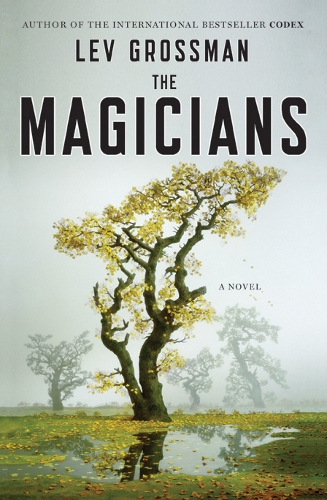
The Magicians by Lev Grossman

Oh there is so much to say about this book! Where do I even start?!

There are, however, some prerequisites needed for you to fully enjoy this book. The first is you have to have read The Chronicles of Narnia by C. S. Lewis, if not in its entirety, then at the very least more than The Lion, The Witch, and the Wardrobe, and most assuredly NOT the movies. Second, you should be familiar with the Harry Potter franchise, in this case the movies or the books are fine. Third, you have to be an avid reader of fantasy, understand it's many cliches in and out, and be somewhat open minded about them. Fourth, I gotta say that you have to be at least over the age of 16 but I'd college experience is highly recommended.

Now before you get ahead of yourselves and go bitching to me about how I'm trying to censure you, read that first sentence again "...for you to fully enjoy this book". Hell, you could not know who CS Lewis or Harry Potter are, never read a fantasy book in your life , and be 12 and I'll bet you might still enjoy this book. You certainly won't catch a lot of the little things, but the writing is solid, and the story is well laid out.

Anyway, this book was unexpected for me. I have a list going of books that I see around my work that interest me and that eventually I need to read, usually I just pick the next book off that list and read that at work, but here I found myself drawn to it. Maybe it was the title--I'm a sucker for magicians anything--maybe it was the fact that one of our competitors broke the laydown date and got us to sell it three days early, or maybe it was the intense endorsement by Martin

"These days any novel about young sorcerers at wizard school inevitably invites comparison to Harry Potter. Lev Grossman meets the challenge head on ... and very successfully. The Magicians is to Harry Potter as a shot of Irish whiskey is to a glass of weak tea."

whatever the reason I read the jacket and dived in.

As I've said on more than one occasion I'm not a fan of book reports, I don't like spoilers, nor do am I very good at summarizing so I'm just gonna talk about what I felt about it. The old adage "Imitation is the highest form of flattery" is so extraordinarily accurate in this case that whoever came up with it must have known this book was coming out. What I mean is this: Grossman has essentially recreated Narnia, mated it with Hogwarts, and thrown in some Tolkien genes. He's said in several interviews that he was absolutely in love with Narnia as a child and wanted to recreate it as an adult with more adult themes, especially the idea of fantasy wearing away as you grow up. He did this with a masterful touch, his characters are nihilistic college kids who essentially have everything, brains, magic, love, etc. but want more. How real is that? We all grow up with these fantasies of changing the world, of how cool and amazing being an adult will be, the absolute kickass-ness of being in college, but what happens? We find out that it all actually kinda sucks. We end up going to college, but within a month the novelty wears off and we're once again in a class room learning about things that we don't care about. Being an adult? Yeah, no kid ever thinks of responsibility or if they do it's in a naive way. Paying bills, having relationships, school, work, social life, everything that goes along with being an adult seems neat, sure, but then it happens and it's just.. blah. We look around after 5 years, 10 years, 40 years, and what have we done with ourselves? Nothing. We work or go to school (both usually), we go home, we eat, we sleep, but there's no real magic to any of it. What happens to that feeling we all get in our stomach about the future? Those butterflies that say everything is going to be amazing tomorrow? They get blindsided by reality. They don't exist. We began to question why we're here, what we're doing with ourselves, whats the point of it all; fall into drugs, alcohol, sex, and depression. This is what being an adult is. It's not magical animals talking to you, fantastic voyages and adventures, it's not fair maidens or evil villains, life is just life. No more. No less. Lev Grossman takes this idea, this horrible realization and puts it in a world where some of those things actually exist. What happens? The characters STILL aren't happy, they're still depressed, they're still nihilistic, and essentially they're still unhappy. What Grossman accomplishes is perhaps one of the best social satires of our generation. The generation of tomorrow, the generation of selfishness, the generation of why.

He's right too. We read fantasy to escape the world, we read it to go some place where things are happy, full of adventure and meaning, but really, would we even be happy there? Is it even possible for us to be happy or even satisfied with anything? He takes Narnia, Hogwarts, and Middle Earth and shows us that, no, we won't ever be happy. Sure it sounds dark, it sounds awful, but it's realistic. It may be exaggerated, most things are after all, but he hit the nail on the head. Us 20 somethings are so dissatisfied with everything that we're losing sight of what really matters. The people we love, our friends, our family, husbands, wives, and kids. We spend so much time trying to be better, trying to find something more, escaping from our own worlds that we lose that which gives our lives the meaning they desperately need. The Magicians is quite the eye opener, at least it was for me. I'm exactly what he described with his book, I have the exact same mentality of these kids, and honestly.. it was both horrifying and hilarious all at the same time. Absurd even.

The best part about it, though, was the fact that unlike dusty old fiction books, The Magicians was stupendously entertaining. Even if you don't read for themes, for so called "deeper meanings", you'll have a hell of a time trying to put his down. The characters are fantastic, you love them, you hate them, and most importantly you connect with them. The world is familiar, both in the sense of the "real world" and that of a Narnia-esqe settings, and the plot is well thought out and well executed. Although some may feel that his almost blatant plagiarism is a turn off, I found that combined with his message it was done not out of malice, but out of love for those works he was so inspired by. Some may think he was just taking Narnia and adding to it for his own monetary gains, but I would have to disagree. Sure there are huge, HUGE similarities between Fillory and Narnia, things are fundamentally different. At times I was a little put off, sure, but looking back on it now after a few books and a month of pondering, I was put off by the realistic tones of the story. I picked up the book, looked at the fantasy label, and assumed it would be just another great happy-go-lucky piece of work, that was quickly shattered. He not only made fun of my mentality, as well he should have, but also that of every fantasy author out there, of every college student, of every person, he managed to criticize things we all have in common in such a way as to make us love and hate him. Some people just criticize, like myself, and people hate them.. but Lev Grossman does what every satirist dreams about, actually accomplishes his criticisms of live, love, and human nature, in a way that people LOVE. It's brilliant!

I'll say this though, it's not for those that are looking for the same old fantasy. It's not for those who like tame stories, or those looking for certain things, it's for those that are almost fed up with the Fantasy cliches, fed up with people, fed up with life. It'll bring you around, lemme tell ya, but like all things it has to be taken with a grain of salt, and an open mind.

Wednesday, September 16, 2009

On the Science Fiction / Fantasy Series

In my last post I spoke briefly about too much story, but what does that mean exactly? Well I've been thinking about this for a while now and I've decided that generally speaking for an author to fully accomplish a sci-fi or fantasy story, it needs to be part of a series. What kind of series you say? Well that depends largely on the authors story, but I think as a very general--there are plenty of exceptions--rule it is safe to say a trilogy works best of all.

The Trilogy

The idea of a trilogy has been around ages and ages in the fantasy world, but it didn't really hit home until Tolkien. The Lord of the Rings is perhaps one of the best series in all of fiction, which includes the silly "Literature" category with Steinbeck, Hawthorn, and other such "Literature" authors. The reason a trilogy works far better in a science fiction or fantasy series is because the author must create an entire world with its very own unique histories, languages, kingdoms, and other such fascinating things. In a "literature" book the hardest part of writing is practically done for you! All you have to do is say "it was 1945, Germany had just fallen! Jake, the onetime Nazi hot shot, is on the run." BAM! That's the entire setting you need to talk about. Sure, you'll talk about the scenery, maybe a sunset here, a dog there, but really everyone knows what earth is like, everyone knows what happened in WWII, everyone knows Germany is in Europe and Europe is across the ocean from the United States. What exactly is there for you to create? A plot, sure, but that's all you're going to be doing; developing characters, developing a plot, and throwing a twist now and then. Sure there are some amazing novels out there that are like this, but my point is that it's easier than creating a whole world of different races, histories, and evil. This is one of the reasons classic literature, like Steinbeck, cannot be compared to any sort of science fiction or fantasy book. Not that they're both hard to write, which they are in their own ways, but the differences make it impossible to even look at the pros and cons of each style. No one will disagree if you say Tolkien was a fantastic author, but it's when you try and compare Tolkien and Steinbeck that you run into problems. This creation of a setting is what makes a trilogy the best for science fiction and fantasy.

Hubbards problem was he tried too hard to fit absolutely everything into one book. Some people can do it, Elantris by Brandon Sanderson is an excellent self contained novel, but others are just too ambitions. The first book in a trilogy sets the tone, it gives the reader a chance to stick his toes into the water, get acquainted with just where they are. The author generally introduces the setting by giving a history of the world/universe, introduces the main characters and their own personal histories within the major world history, and introduces the plot. It doesn't seem like much, but it's a lot more than you realize. Personally I love knowing the ins and outs of this fantasy world; its government, economics, wars, races, languages, and all that other stuff that is generally taken for granted in literature. In order to do this you cannot write it like a history book, people don't like to read textbooks, the best way is to do this in bits and pieces. I've found that a prologue does the job quite well, you're introduced to the land and its history, and then to the main character. From there the author will usually jump through time and into the present (for that character) and as the character goes on his journey/quest/voyage we learn more about the world as we go along. Sadly this makes for a perfect cliché because the easiest way to give the maximum amount of information through the characters journey is to have the character from a small town. Yeah, this has lead to the farm boy, fisherman, hobbit, or generally "innocent" character finding his way through the big, scary, complex world through interaction. It's really not a bad way to go in my opinion, but it certainly gets old after a while.

After the author has done all his introductions and sent his character on his quest it is time for the sequel. The sequel or middle book in a trilogy is generally, at least in my opinion, the driest of the three because it's all plot/character development.
LotR: The Two Towers
,
Shadows Edge, The Ring, and
Redemption Ark
are but a few examples of sequel books that don't live up to the trilogies as a whole. The reason for this stems from the fact that as the middle book they have a lot to live up to and yet have less interesting things to talk about. From my experiences the middle child of a trilogy is mainly there to bulk up the plot, enhance the character and world histories, and lead up to a stunning conclusion. Because of this they never get the chance to really shine! By this point in writing an author generally knows it's going to be a trilogy and so immediately they're jumping to the conclusion in their heads, but are stopped by the fact they have a lot of plot and build up to do. Don't get me wrong, there are some absolutely amazing sequel books out there--Green Mars, and pretty much all of Raymond E. Feists trilogies are solid the whole way through--but a lot of times the author just gets ahead of themselves and doesn't put as much effort into the second book as they do in the first or third.

As for the third, well, that's where the magic happens.. usually. By this point in the series you're in love with the characters, the world, and the plot, you're just begging the author to finish up and tie up all those loose ends to form a fantastic ending. Well 9 times out of 10 they deliver. My theory is this; all the good books out there aren't written for the fans, for the author's wife, for anyone, all the very best works are written for the author. This usually means that the last book is a work of pure genius! As much as we the reader feel attached to the story and want it to go on, the author is a million times more into it and that translates right into the book. Where they were hesitant in the first, clearing up details in the second, they are letting loose with their creative talent in the final chapter of their trilogy. Just look at some of them out there, Return of the King (obviously), Absolution Gap, and Beyond the Shadows are all fantastic! Unfortunately, because the author is a lot of times writing for his or herself, the fans can be let down by this third novel. In as much as they want us to be happy, they want to be happy, and generally--especially with high profile undertakings--the conclusions sought by the fans, are not what the author delivers. Sure they'll deliver an epic, a masterpiece; a piece of art, but sometimes the execution isn't all that it should be. Harry Potter and the Deathly Hollows is, even though it's not a trilogy, a more than perfect example. In fact, I would wager to say that the ending to that book almost ruined the entire series for me. This is partly due to hype, popularity, and poor writing style. It's a sad fact that really shitty books tend to be best sellers, and let's face it J.K. Rowling is not the best author out there, so even though she created a cult phenomenon, she didn't have the experience to finish it off properly and the whole series suffered for it. This happens a lot with novice authors, but hey you have to get out there sometime, you gotta write that book, and you gotta just suck up the bad reviews because there's always a critic out there. In any case, the third and final book in a trilogy is where the real fireworks are; by this point the author has established enough of a setting that they can throw the reader on twists and turns and betrayals, which usually leads to epic books!

This is why, in my humble opinion, a trilogy is by far the best formula for a science fiction or fantasy story.

~~~~~~~~~~~~~~~~~~~~~~~~~~~~~~~~~~~~~~~~~~~~~~~~~~~

A Side Note

Even as I wrote that last sentence I knew I wasn't done with this post. Indeed, I have to mention that although I do really think the trilogy is the best means to achieve a fantasies creative end, there are other ways. First of all it is possible, like I mentioned, to write a fully self contained fantasy novel, hey, you can write a damn good one even, but it takes a lot of skill some authors don't have. Along the same lines you can write a stunning duology, which also takes a great deal of skill, but allows for more room to play. Karen Miller's Kingmaker Kingbreaker duology is the best example I can come up with off the top of my head. I was a little worried at first, this was her first step into the non-licensed fantasy world (she's written a couple books in the Star Wars Universe) and as such I wasn't sure if she could pull it off. Oh how she did! It has just the right amount of world, religion, and character building for the reader to completely become immersed in and on top of that she has a damn good plot. Sadly the duology isn't a very popular media for authors, I think because they get so into it that they end up with a trilogy, but when it's done well I think it can rival that of a trilogy in some aspects. Those generally tend to be if you're writing a less complex world/story than that of LotR, smaller map, fewer characters/races, smaller timescale as a whole, which can be refreshing. As much as a love the appendices of LotR, sometimes it's nice to relax in a less complex world. Of course you can always go bigger with a quartet or even a quintet, but then you're moving into the realm of an epic.

~~~~~~~~~~~~~~~~~~~~~~~~~~~~~~~~~~~~~~~~~~~~~~~~~~~

On Epics

So your story is too deep for a novel, duology, or a trilogy huh? Well then my friend, you're writing an epic! We've all seen them, we all love them, the epic series are those that flow through multiple volumes over multiple time frames. Think Frank Herbert, Raymond E. Feist, Terry Goodkind, Robert Jordan, and George R.R. Martin, these are the big wigs. These are the ones that will blow your mind over and over and over again, that will keep people talking for years, these are the ones that go down in the history books! Naturally there is a higher degree of error here, Terry Goodkind lost it toward the end by injecting his story with Ayn Rands philosophy, Robert Jordan died, and Martin, well Martin just won't release the next book in the series. But hey, all that aside, and these are some of the best books out there. The interesting thing I find with these is that although the worlds are that much more detailed than trilogies and the other forms, they aren't as detailed as one would expect, usually these epics are super plot heavy or, on the contrary, follow several different plots all in the same universe. The Enderverse is an amazing combination of both, Orson Scott Card delivers an amazingly detailed complex plot over several books, and then flawlessly jumps thousands of years and yet still keeps the magic. Herbert did the same with the Dune series, writing a fantastic plot before jumping thousands of years and pulling out a new plot tied to the old. *sigh* Dune is just the definition of epic--not the silly gamer definition either--but the old school Odyssey epic!

Perhaps my favorite form of epic is that of an established universe with many branches. Think of it this way, you have a trilogy that makes up the trunk of a tree--we're talking redwood trunk here--that establishes this stunning universe with hundreds of thousands of story possibilities, and then the author ads some creative water and BAM! You have on your hands a tree so full of stories, characters, love, and grief that it almost brings a tear to your eye. This is my favorite style of fantasy/science fiction because you fall in love with the main trilogy, the main universe, the main characters, but instead of dragging on the plot *cough GOODKIND cough*, they end their trilogy and branch off in their newly formed realm. Isaac Asimov did this, though I've only read the Foundation trilogy, to an extent Tolkien did this with his follow up books The Silmarillion, The Unfinished Tales and other such works*, but the two authors that have done this the best are Raymond E. Feist and Alastair Reynolds.

Feist is an interesting case, his series is based off that of a single duology, though first published as one novel, and then proceeds to follow the main characters and the main characters children, and then their children. All the while keeping a few of what I like to call uber-characters throughout the entire time span. Pug, Tomas, and Marcos the Black all make appearances in the books even though they're set decades in the future. This may sound silly, but it's explained perfectly, don't trust me go read it! But the best part is how Feist incorporates the stories of his first books and turns them into legends in the later books. Battles you read in the first books all morph into something more as the years go by, mere mortal characters become god-like kings, and villains turn into the stories used to scare kids at night. I can't even give do justice to Feist, all I can say for sure is that you need to read it! Fantasy

Reynolds, on the other hand, is more of the tree-like epic writer I mentioned earlier. His Revelation Space Trilogy is by far one of the most amazing things I have ever read and it only gets better! Included in that one, because it falls under the same time-line ish, is Chasm City a standalone novel that introduced me to this style of writing; basically what Reynolds did was create this fantastic universe (and I do mean universe literally), write a jaw dropping trilogy in that universe, and then proceed to write other stories, novels, and novellas within that universe. All the while Reynolds is developing and changing and enhancing this universe to the point that if he wanted to, he could only write books set there for the rest of his life and never run out of stories. I really didn't even realize the scope of this until I picked up Galactic North which is a collection of eight short stories and novellas, all independent and utterly amazing within their own right. Shortly after that I picked up Diamond Dogs Turquoise Rain, two novellas that completely blew my mind! And since then I've read four or five of his short stories within sci-fi anthologies! The possibilities are endless for this series and like Feist, some of the things you witnessed in the original trilogy turn up again in fan pleasing ways!


~~~~~~~~~~~~~~~~~~~~~~~~~~~~~~~~~~~~~~~~~~~~~~~~~~~


You know I set out to kind of outline my favorite style of sci-fi/fantasy, but it turns out I can't narrow it down. I adore Herbert, Feist, and Reynolds for their epic masterpieces, but at the same time Tolkien will always have a special place in my heart with The Hobbit and The Lord of the Rings, and even smaller than that I've read countless novels and short stories that will always be remembered as fantastic. It really all comes down to the story in the end. Some are just meant to be many books, others are meant to be a 20 page short story, but all of them—with a few exceptions of course—are amazing. It's true, just looking at my bookcase I obviously prefer longer story arcs than shorter ones, but I think part of the reason is because I've been lucky enough to read only the best of the best! I know people that have read a longer story arc, hated it, and will never pick up anything more than a trilogy, but I also know people that refuse to read anything other than the super long stories. Each style has its own pros and cons, its ups and downs, it's good and bad, but hey, that's what makes sci-fi/fantasy such a dynamic genre! Nowhere else can you find such a wide range of reading options as in the sci-fi/fantasy realm, indeed nowhere else will you find all in one place more worlds, universes, and characters than a trip into the sci-fi/fantasy section. I love literature, I love mystery/thriller, and I'm enjoying non-fiction more and more, but nothing will be as close to my heart as science fiction and fantasy are.